
New top story from Time: Justin Theroux Is Great in The Mosquito Coast. But What Is This Muddled Meditation on American Life Trying to Say?

https://ift.tt/3gJbl6G

There’s something singular about Justin Theroux. Compared with the other leading men of his generation, the star of the new Apple TV+ series The Mosquito Coast has a presence less delicate than Leonardo DiCaprio or Jude Law, less fratty than Matt Damon or Ben Affleck, less anxious than his closest analogue, Ethan Hawke. What defines Theroux, aside from abs that have been known to make the paparazzi pant, is a brooding, cerebral sense of alienation. After 25 years in Hollywood, a celebrity marriage with ex-wife Jennifer Aniston and recently an Esquire cover, he still reads as an outsider. That quality has never felt more pronounced than it does now, as he approaches 50 and embraces what could, albeit reductively, be called his Hot, Crazy Dad period.

Theroux is not a father in real life—nor is he, as far as I know, authentically unhinged—but he played a Hot, Crazy Dad to unforgettable effect in HBO’s haunting philosophical drama The Leftovers. His role in The Mosquito Coast, an action-packed adaptation of his uncle Paul Theroux’s popular 1981 novel that debuts on April 30, puts a less sympathetic spin on the archetype. And while this updated take on the story doesn’t come close to delivering on its lofty thematic ambitions, Theroux’s dynamic, layered performance transcends the cluttered script.

Paul Theroux’s book, which was adapted as a feature film in 1986, is an allegory for the vicious circle of colonialism nested within an adventure narrative. A genius inventor who dropped out of Harvard, protagonist Allie Fox lives on the margins of American society with his adoring family and nurses a cranky, self-serving obsession with consumerism. (Theroux’s bone-deep embodiment of this character illustrates just how miscast Harrison Ford was in the movie.) Also, he’s created a machine that can transform fire into ice, but nobody cares because there’s plenty of frozen water in the U.S. So the Foxes light out to the Central American jungle, where Allie exploits cheap land, abundant natural resources and cooperative locals to create his ideal society—creating the ultimate test case for his invention and, in effect, restarting the cycle of industrialization he’s trying to escape. As the family’s circumstances devolve, what began in the vein of Robinson Crusoe or Huckleberry Finn starts to look more like Aguirre, the Wrath of God.
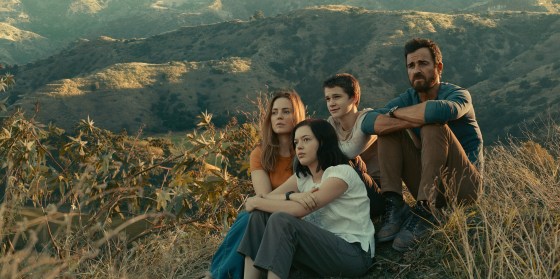
L-R: Melissa George, Logan Polish, Gabriel Bateman and Paul Theroux in ‘The Mosquito Coast’

It would be tough to tell precisely this story today, in part because of how much the geopolitical conversation has complexified over the past four decades and in part because, although Allie is the butt of its satire, it relies on what Disney+ has notoriously euphemized as “outdated cultural depictions.” So writer Neil Cross (Luther), who adapted the book for TV with Tom Bissell, was wise to make major plot adjustments. In Apple’s seven-episode series, Theroux’s Allie is still a self-righteous, anti-American eco-MacGyver who can’t sell his fire-to-ice converter. (Did he pitch George R.R. Martin?) But this time, he and wife Margot (Melissa George) have spent a decade or so on the run from the government following some mega-crime that remains unknown to viewers—and to the Foxes’ children. While her little brother Charlie (Gabriel Bateman) hangs on Allie’s every boast, 15-year-old Dina (Logan Polish, excellent) is growing increasingly frustrated that her parents’ off-the-grid lifestyle prevents her from doing such normal-teenager things as spending hours on a cellphone with her boyfriend. She really isn’t pleased when, with the feds suddenly hot on their trail again, her father forces the family to bolt for the southern border.

This Mosquito Coast becomes a fugitive road-trip tale, with Allie enlisting coyotes to smuggle the Foxes into Mexico, where he hopes to find sanctuary for the family with a shadowy network of outlaws. In doing so, he places his family in grave danger and leaves a long trail of bodies in his wake. There are conspicuous echoes of our ongoing immigration disaster, the War on Drugs and the climate crisis. As in the original, Allie is a man disgusted by American chauvinism who can nonetheless never escape it because he epitomizes it, in his own selfishness, ego, reliance on manipulation and seeming lack of comprehension that other people are discrete human beings with their own justifiable needs and preferences. This much is clear within the first few hours, but instead of deepening the metaphor as it progresses, the show simply repeats itself.

That leaves time for multiple action sequences, as well as multiple scenes of various Foxes being lost, scared and alone in the world, in every episode. Both can feel like time wasters. Unmoored from its source material, The Mosquito Coast can’t seem to decide if it wants to be a white-knuckle thrill ride, a character-driven family drama, a high-minded critique of 21st-century America, or—once we’re introduced to a cartel assassin who’s dressed like Walter White in his all-black Heisenberg getup and flanked by a neo-Dickensian army of child urchins—a second-rate Breaking Bad. The show gets so wrapped up in building suspense that its finale lands with an infuriating thud, leaving crucial questions unanswered and central relationships unresolved. It ends so abruptly, I had to double-check the press notes to be sure I hadn’t missed an episode.

Apple TV+Justin Theroux and Melissa George in ‘The Mosquito Coast’

This is a series that’s always tantalizing viewers with glimpses of profundity—in its political commentary, its plot complexity, its character development. But only in Theroux’s performance does The Mosquito Coast transcend the superficial. During his anti-society soapbox rants Allie can come across as a raving loon of the most dangerous sort, yet in this rendering he’s also charming and brainy enough to suggest why Margot didn’t just grab the kids and run years ago. He’s more than a standard TV narcissist, however; he rarely falls apart when anyone questions him, and is in fact at his gentlest and most patient after someone, usually Dina, betrays him. And he seems to sincerely believe he loves his family, even if he thinks too highly of his own intelligence to value their perspectives on technology or consumerism or whether it’s a good idea to plunder the belongings of a bunch of migrant corpses they stumble upon in the desert.

Within the first 15 minutes of the premiere, viewers get a pretty thorough sense of Allie’s values. And it’s through Theroux that we, more gradually, come to understand the show’s conflicted depiction of Allie. The lingering question is also the most important one: where do Cross and Bissell ultimately come down on consumerism or technology or any other aspect of contemporary American life? Maybe such candor is too much to ask of a show created for a platform owned by one of the world’s most valuable corporations. Sadly, the alternative leaves us with a commercial for thinking about America more than a complete thought.

Comments

Popular posts from this blog

New top story from Time: How 3 Key In the Heights Scenes Were Reimagined From Stage to Screen

https://ift.tt/3iIBhAh When director Jon M. Chu first saw the musical In the Heights on Broadway in 2008, his imagination whirred to life with possibilities. “Imagine if this was in a tunnel and the tunnel lights up?” he remembers thinking while sitting in the theater. “Imagine if you could look through a window of somebody dreaming, and the community could be reflected in the reflection?” More than a decade later, Chu is bringing these reveries to life as the director of the musical’s film adaptation, which arrived in theaters and on HBO Max on June 11. While other recent film-to-stage adaptations — like Ma Rainey’s Black Bottom and One Night in Miami — have leaned into the intimate, contained aesthetic of theatrical performances, Chu’s In the Heights has the ambition and scale of the most epic blockbuster films, complete with hundreds of extras and dancers, vibrant animated graphics, gravity-defying Fred Astaire-inspired dance numbers, and plenty of slick camerawork ...

US Capitol breached by Trump supporters, woman killed; Joe Biden says 'dark moment' https://ift.tt/3oo7Za2

In an "unprecedented assault" on democracy in America, thousands of angry supporters of President Donald Trump stormed the US Capitol and clashed with police, resulting in casualty and multiple injuries and interrupting a constitutional process to affirm Joe Biden's victory in the presidential election.

'Situation not normal, don't lower guard': Delhi's 1st COVID patient cautions people https://ift.tt/35GmCxs

As many continue to take leeway during the festive season, Delhi's coronavirus patient has cautioned people to stay indoors as much as possible because "situation is not back to normal". Rohit Datta, who was diagnosed with the infection on March 1, appealed to the masses to "not lower guard" by getting into a casual festive mode. 

New top story from Time: The Security Perimeter Around the Capitol Starts to Recede — and Washington Feels a Little More Normal

https://ift.tt/3ssgaEo This article is part of the The DC Brief, TIME’s politics newsletter. Sign up here to get stories like this sent to your inbox every weekday. Washington isn’t a city particularly known for its rationality. We do overreaction better than most, and that talent is rivaled only by underreaction. Passions fuel far too much public policy, personalities dictate what is possible and personal relationships often triumph over pragmatism. It’s something I usually bemoan and curse under my breath — or, increasingly, in this newsletter. So you’ll forgive a moment of indulgent irrationality and some merriment. For, you see, the fencing around the U.S. Capitol has come down. Well, not all of it. And the barriers that remain don’t have an expiration date and may never get one. But at least some of the garish barricades that went up in response to the deadly failed insurrection on Capitol Hill on Jan. 6 have been dismantled. The razor-wire on its top is gone, too...

New top story from Time: Our Eyes on the Virus: Why We Still Need Widespread Rapid Testing Even With Vaccines

https://ift.tt/3i5MoTN The vaccines are here. Why do we still need testing? Testing is our eye on the virus. Without testing, we can’t see where it is or where it is going. As fall and winter set in, outbreaks will again occur, sparked by the unvaccinated. And most people become infectious before they know they are infected. Frequent and accessible rapid testing is a tool that if deployed last summer and fall would have saved 100,000 lives. The U.S. missed the opportunity to use frequent rapid testing to stop individuals from unintentionally spreading the lethal SARS-CoV-2 virus to our most vulnerable and avert the horrific winter surge. By rapid tests, I mean the tests that an individual can conduct without a laboratory (ideally in the privacy of their own home) with results given in real-time. There are two types: rapid antigen tests, which look for the virus’s proteins and detect infectious levels of virus. The other lets you know you’ve been infected: rapid molecular...

FOX NEWS: Toddler admitted into American Mensa has an IQ of 146, makes history as youngest member A 2-year-old girl has just made history as the youngest member of American Mensa.

Toddler admitted into American Mensa has an IQ of 146, makes history as youngest member A 2-year-old girl has just made history as the youngest member of American Mensa. via FOX NEWS https://ift.tt/3yHFGc7

New top story from Time: Germany Has Officially Recognized Colonial-Era Atrocities in Namibia. But For Some, Reconciliation Is a Long Way Off

https://ift.tt/3fVRkaO The German government formally recognized colonial-era atrocities against the Herero and Nama people in modern-day Namibia for the first time, referring to the early 20th century massacres as “genocide” on Friday and pledging to pay a “ gesture to recognize the immense suffering inflicted.” “In light of the historical and moral responsibility of Germany, we will ask Namibia and the descendants of the victims for forgiveness,” said German Foreign Minister Heiko Maas in a statement , adding that the German government will fund projects related to “reconstruction and the development” of Namibia amounting to €1.1 billion ($1.3 billion). The sum will be paid out over 30 years and must primarily benefit the descendants of the Herero and Nama, Agence France-Presse reported . [time-brightcove not-tgx=”true”] Although it’s a significant step for a once colonial power to agree such a deal with a former colony, there’s skepticism among some experts and ob...

New top story from Time: The Most Powerful Court in the U.S. is About to Decide the Fate of the Most Vulnerable Children

https://ift.tt/34relNF When child custody cases come before family courts, judges endeavor to base their rulings on the best interests of the child. Overall, the court is less interested in which parent might have the most right to the children than in how best to help the children thrive. The Supreme Court might now be walking a very similar line. It is on the verge of deciding a landmark case that could have a profound impact on the more than 400,000 vulnerable children who find themselves in the U.S. foster care system. Its ruling could also have major implications for LGBTQ rights, religious liberty and nondiscrimination laws across America. [time-brightcove not-tgx=”true”] The case, Fulton v. City of Philadelphia , was sparked when the city said it would no longer contract with a faith-based agency, Catholic Social Services (CSS), to provide foster services after a 2018 Philadelphia Inquirer article revealed that it would not certify same-sex couples to be foster pare...

New top story from Time: 2021 Could Be the Biggest Wedding Year Ever. But Are Guests Ready to Gather?

https://ift.tt/3wC3WKU I was supposed to get married in September. Well, technically, as my husband would be quick to correct me, I did get legally married in September 2020 in the courtyard of our New York City apartment building in front of our parents, a handful of friends who lived nearby and a naked guy standing in the window of the building next door, who, I am told, cheered when we recessed. The 13 people in attendance wore masks I’d ordered with our wedding date printed on them, sat in distanced lawn chairs and sipped gazpacho I’d blended and individually bottled that morning in a frenzy of health-safety panic. [time-brightcove not-tgx=”true”] This was not the wedding of 220 people that we had originally planned. A few months into the pandemic, we made the call to delay our big celebration until 2021. We were hardly alone. In a typical year, Americans throw 2 million weddings, according to wedding website the Knot. Last year, about 1 million couples in the U.S. post...

New top story from Time: Constance Wu and Jenny Han on the Power of Inclusive Storytelling

https://ift.tt/3wFvLCm In conversation with senior editor Lucy Feldman as part of TIME’s “Uplifting AAPI Voices” summit , actor Constance Wu and To All the Boys I’ve Loved Before author Jenny Han discussed their groundbreaking work both in front of and behind the camera, the need for nuanced Asian American and Pacific Islander (AAPI) representation and their love for a good rom-com. TIME: When the film adaptations of Crazy Rich Asians and To All the Boys I’ve Loved Before first came out, there was a whole generation of Asian Americans who had never seen ourselves reflected like that. What did those films mean to you? And how did they change things? [time-brightcove not-tgx=”true”] Wu: I was in a unique position, having that happen to me with two big-profile projects: first there was Fresh Off the Boat, which was seeing yourself represented on network American TV. That was something that really hadn’t happened in a long time. Crazy Rich Asians was on a bigger sc...