
New top story from Time: India’s Vaccine Rollout Stumbles as COVID-19 Cases Decline. That’s Bad News for the Rest of the World

https://ift.tt/3ayh1gr

India’s COVID-19 vaccination scheme looked set for success.

For the “pharmacy of the world,” which produced 60% of the vaccines for global use before the pandemic, supply was never going to be a problem. The country already had the world’s largest immunization program, delivering 390 million doses annually to protect against diseases like tuberculosis and measles, and an existing infrastructure that would make COVID-19 vaccine distribution easier. Ahead of the launch, the government organized dry runs, put up billboards touting the vaccines and replaced phone ringing tones with a message urging people to get vaccinated.

And yet, one month into its vaccination campaign, India is struggling to get even its health workers to line up for shots. In early January, India announced a goal to inoculate 300 million people by August. Just 8.4 million received a vaccine in the first month, less than a quarter of the number needed to stay on pace for the government’s goal. So far, vaccinations are only available for frontline health workers, and in some places police officers and soldiers.

And even that initial interest might be waning. India’s vaccine scheme relies on a mobile phone app that schedules vaccination appointments. On the first day doses were administered, Jan. 16, some 191,000 people showed up. But four weeks later, when those people were summoned for the second dose, only only 4% returned.

A. Valsala, a community health worker in the southern city of Kollam who spent months fighting COVID-19 door-to-door, skipped her appointment to get her first dose of the vaccine after a hectic day on Feb. 12. “I don’t feel the need to rush because the worst is over,” she says. “So there is a sense that it is okay to wait and watch since there are concerns about how these vaccines were developed so fast.”

Read more: How the Pandemic Is Reshaping India

A. Valsala’s comments point to a troubling trend—one reflected in TIME’s interviews with health workers across India. A combination of waning COVID-19 cases nationwide, questions over the efficacy of one of the two vaccines currently authorized for use in the country and complacency are resulting in growing hesitancy to get vaccinated.

“There is a reduced perception of threat with regard to the virus,” says Dr. Chandrakant Lahariya, a New Delhi-based epidemiologist. “Had the same vaccines been available during the peak of the pandemic in September and October, the uptake would have been different.”

A troubling sign for the rest of the world

Public health experts are now concerned that the sluggish start could impact the subsequent phases of the vaccination drive, especially when the vaccination scheme is widened next month to include older people and those with preexisting conditions.

“In India, people have an inherent trust in doctors,” says Dr. Smisha Agarwal, Research Director at the Johns Hopkins Global mHealth Initiative. “So when [doctors] don’t turn up to get vaccines, it reaffirms any doubts that the general public might have.”

In an effort to accelerate the vaccination drive, the government started walk-in vaccinations as opposed to allowing only those scheduled for the day to get the shots. It also set up new vaccination centers across the country.

Read more: The U.S. COVID-19 Vaccine Rollout Is Getting Faster. But Is It Enough?

For now, India might be an outlier: a country with a surfeit of vaccines with few takers. But its experience shows that, while the first challenge is stocking up on vaccine supplies, convincing people to take them can be its own huge task. It might be a portent for the rest of the world as the number of COVID-19 cases decline globally and vaccines become more widely available, warns Dr. Paul Griffin, an infectious diseases specialist at the University of Queensland in Brisbane.

It’s easy to be complacent about getting a vaccine when cases are declining, Griffin says, “but now, when the trajectory looks favorable, is the right time to step back and realize that this will be our reality for a long time if we don’t speed up the vaccinations at this moment.”

How India fell behind on vaccinations

A syringe and a Covishield vaccine vial are seen on a plate during the Covid19 vaccination in Kolkata on Jan. 19
Sumit Sanyal—SOPA Images/ShutterstockA syringe and a Covishield vaccine vial are seen on a plate at the Urban Primary Health Centre in Kolkata on Jan. 19

Despite being well-positioned, India’s vaccination drive got off to a rough start. The hasty approval of the country’s homegrown vaccine, Covaxin, with little data available while Phase 3 trials were still underway (those remain ongoing) drew criticism from health workers and scientists. The mainstay of India’s vaccination scheme is Covishield, the Indian variant of the vaccine developed by University of Oxford and AstraZeneca, which has been approved by regulators in the U.K., the E.U. and elsewhere. However, Covaxin is the only vaccine on offer in some vaccination centers in urban areas and health workers don’t get to choose which jab they receive.

“Covaxin might be efficacious but what guides me is data,” says Dr. Nirmalya Mohapatra at the Dr. Ram Manohar Lohia Hospital in New Delhi, where only Covaxin is available. “We also want vaccines faster because we have seen deaths because of this disease but that doesn’t mean we should cut corners with the data.” Mohapatra has refused to take Covaxin until more data is available.

But even for Covishield, there aren’t as many takers as expected. In the western city of Nagpur, fewer than 36% of those scheduled to take the vaccine turned up Feb. 11, as per a Times of India report. In the north, the city of Chandigarh is planning to set up counselling centres to dispel fears about the vaccines. In a hospital in the southern city of Thrissur, Dr. Pradeep Gopalakrishnan was the last one to get the vaccine on the morning of Feb. 8. “No one came in after me, so around 69 doses set aside for the day remained unused,” he says.

Experts say the lack of enthusiasm could also be attributed to a decline in cases. India’s daily case average has dropped to less than 12,000—down from more than 90,000 in September. At the peak of the pandemic, health care systems were overwhelmed, with shortages of hospital beds and oxygen cylinders being reported across the country. India’s official COVID-19 tally, now at nearly 11 million, surged to No. 2 in the world, behind the U.S (where it remains to this day).The Vaccine Champions in

Read more: France Defying Death Threats to Convert Anti-Vaxxers

In a Feb. 4 press conference, the Indian Council of Medical Research said that more than 20% of subjects over age 18 from across the country tested in late December and early January had antibodies for the coronavirus that causes COVID-19, meaning they likely had the disease and recovered. Similar studies in Mumbai and Delhi showed even higher levels of antibodies—up to 56%, according to Delhi’s health minister. Several health workers interviewed by TIME said they contracted COVID-19, and were less concerned about getting the vaccine immediately because they believe they have immunity.

But health experts warn India is far from herd immunity. And many worry that people not taking vaccines seriously might not bode well for India, given that other countries’ later waves of COVID-19 were even more severe than those early in the pandemic. Already, Maharashtra, the worst-hit state in the country, has seen a COVID-19 spike in recent days, with daily cases above 5,000 on Feb. 18 for the first in two and a half months

‘The worst is not over yet’
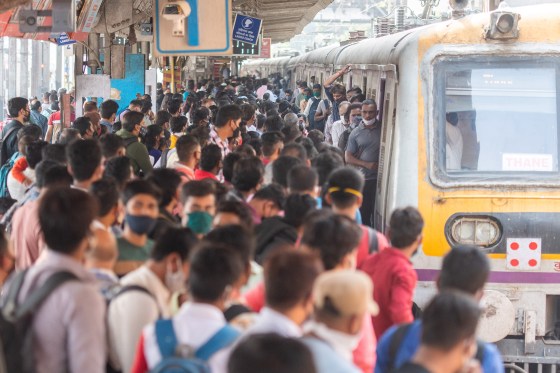
A rush of travellers wait to board a suburban local train at Dadar station, Mumbai, on the first day when local train services started for general public on Feb 1.
Pratik Chorge—Hindustan Times/Getty ImagesA rush of travellers wait to board a suburban local train at Dadar station, Mumbai, on the first day when local train services started for the general public on Feb 1.

On a global level too, the tendency to let the guard down might hamper efforts to bring the pandemic under control. Experts say vaccination is necessary not only to get long-term immunity but to also reduce the potential for new mutations, which are largely behind recent surges in cases in the U.K and Brazil.

“High vaccination coverage rate reduces the potential for new variants,” says Griffin of the University of Queensland. “The more cases we have in circulation, the more chances there are of generating mutations that confer some kind of benefit to the virus.”

Even in countries like the U.S. and the U.K., where vaccination started during a surge in cases, there is a risk that people lose enthusiasm once cases decline. Experts emphasize the need for better communication with the public to ensure that vaccination drives don’t slow down with COVID-19 case counts.

“There isn’t any time to wait because the worst is not over yet,” says Agarwal of Johns Hopkins. “Despite the fatigue, ramping up the vaccination is the only and best weapon we have against what might otherwise be a very long winter.”

Comments

Popular posts from this blog

'Not Joining BJP', Sachin Pilot clears the air amid speculations surrounding political future https://ift.tt/2DDIvTz

Sachin Pilot has reiterated that he is not joining BJP amid speculations surrounding his political future after he openly rebelled against the 'slavery' of the Congress high command. Pilot has reportedly told news agency ANI that he will not be joining BJP.  from IndiaTV: Google News Feed https://ift.tt/32mgY3o

FOX NEWS: Dog earns Guinness World Record for longest ears This dog can definitely hear it when people say he’s a good boy.

Dog earns Guinness World Record for longest ears This dog can definitely hear it when people say he’s a good boy. via FOX NEWS https://ift.tt/3zKc8tR

MLA hostel in Mumbai evacuated after bomb scare https://ift.tt/3n307dK

An MLA hostel in south Mumbai was evacuated after the city police received a phone call about a bomb being placed in the building, an official said on Tuesday. However, no bomb was found after a search in the premises and the phone call turned out to be a hoax, he said. The incident took place on Monday night when an unidentified person called the police, saying a bomb was placed inside the Akashvani MLA hostel, located near the state secretariat, the official said.

New top story from Time: In the Gently Moving Minari, a Korean Family Finds Home in America’s Heartland

https://ift.tt/3ksxkyn Most stories about immigrants adjusting to America take place in cities, environs where a newcomer may already have family or friends, or at least be able to find a community. The family in writer-director Lee Isaac Chung’s Minari takes a different route: Jacob and Monica (Steven Yeun and Yeri Han) have come to America from Korea to seek better opportunities—we don’t know much more than that. But we do learn that Jacob has a dream of growing things, of being a farmer. Jacob, Monica and their two young children, David and Anne (Alan Kim and Noel Cho), have lived for a time in California, but as the movie opens, we see them driving to what will be their new home: A blocky rectangle of a house propped on cinderblocks, adjacent to a stretch of land that looks like paradise to Jacob—but not to Monica. She says little at first, but her stern silence tells us what she’s thinking: Why have you brought us here? This is 1980s Arkansas; there may be a few Koreans ...

New top story from Time: To Build Back Better, Tax Ultra-Wealthy Families Like Ours

https://ift.tt/2Y1lvIB After a summer of speculation, the contours of the deal needed to pass President Joe Biden’s popular “Build Back Better” agenda are becoming clear. To win key votes , Congress will have to find fresh sources of revenue to match new spending. Fortunately, there is an economically sound, overwhelmingly popular path that the President is endorsing: requiring ultra-wealthy families like ours to pay more in taxes. Doing so would mean reforming a tax code that allows the wealthiest to build and maintain fortunes without paying their share in taxes. Ultra-wealthy families further reduce their tax burdens to a pittance by deferring sale of their appreciated assets, borrowing against those assets and structuring their charitable giving. From 2014 to 2018, America’s 25 wealthiest people amassed a combined $401 billion, but in some years paid zero federal income tax, according to ProPublica . The Biden Administration calculates that America’s richest 400 famil...

New top story from Time: Jasper Johns: “Dying While on Assignment Doesn’t Seem Like a Bad Idea”

https://ift.tt/39PD2WS Jasper Johns, possibly America’s most famous living artist and still plying his trade at 91, launches two retrospectives on Sept. 29; one at the Whitney Museum of American Art in New York City and the other at the Philadelphia Museum of Art . The exhibitions, known collectively as Mind/Mirror, illuminate the through lines of Johns’ large body of work: his fascination with such everyday symbols as numbers, targets, maps and flags; his sometime habit of limiting his color palette to red, blue, yellow and orange; and his exploration of such techniques as collage, hatching and scale. One section of the Whitney is dedicated to his variations on the motif of a Savarin coffee can crammed with brushes, which is widely believed to be the artist’s way of representing himself. Johns, who famously destroyed all his prior work before painting his first flag, lives in Connecticut and rarely gives interviews. He answered questions from TIME via email. [time-brightco...

New top story from Time: The Overlapping Worlds of Author Amor Towles

https://ift.tt/3AUkxMM Amor Towles had never actually been beneath the vaulted ceiling of an Adirondack lake house when he described the one in his 2011 debut, the best-selling Rules of Civility . He could only imagine the appeal of such an exalted communal space—“this great room where the family gathers”—until, while shopping for a second home with the money from that book, he found himself touring a property an hour and a half north of Manhattan. “I was like, This is it!” says Towles, throwing his arms toward a 30-ft. ceiling that, like the glistening lake outside, now belongs entirely to him. “It was this weird thing where I was kind of buying the living room that I had written about,” he says. “Which, in a Stephen King novel, would end badly.” [time-brightcove not-tgx=”true”] In the storybook life of Amor Towles, however, the new owner lays down thick Oriental rugs (thicker still where they overlap), sets his laptop on a long oval table by floor-to-ceiling windows and—...

New top story from Time: Here’s What We Learned From Three New Britney Spears Documentaries, From Secret Surveillance to #FreeBritney Infiltrators

https://ift.tt/3m9avBb A flurry of new documentaries centered on Britney Spears and her court-ordered conservatorship have shed more light on the immense hardship that Britney has faced over the course of the 13-year legal arrangement. The three specials—FX and the New York Times’ Controlling Britney Spears , CNN’s Toxic: Britney Spears ‘ Battle for Freedom and Netflix’s Britney Vs Spears —were all released in the week leading up to Britney’s highly anticipated Sept. 29 court date, a hearing at which Los Angeles County Superior Court Judge Brenda Penny is expected to address Britney’s petitions to remove her father, Jamie Spears, as conservator and terminate the conservatorship as well as Jamie’s own unexpected petition to end the arrangement . [time-brightcove not-tgx=”true”] Attention surrounding the hearing and the fan-driven #FreeBritney movement has continued to ramp up in recent days as reports of shocking new details regarding Britney’s case, as alleged by t...

New top story from Time: Atlanta’s First Black Female District Attorney Is at the Center of America’s Converging Crises

https://ift.tt/2Y1oy3U So much of what is ugly and unhinged about America can be seen in the eyes of a mother whose 8-year-old is dead. But, on a Tuesday in August, at Atlanta’s downtown courthouse, that’s where Fulton County, Ga.’s district attorney, Fani Willis, is looking. She’s meeting with Charmaine Turner and Secoriey Williamson, the parents of Secoriea Turner , a chubby-cheeked Black girl with generous eyebrows, who liked to make TikTok dance videos and throw up peace signs in candid pictures. A bullet pierced her back and killed her last year after she attended a Fourth of July fireworks show. Secoriea’s killing was random, but part of a larger story. On June 12, 2020, an Atlanta police officer fatally shot Rayshard Brooks in the parking lot of a Wendy’s, setting off protests. By Independence Day, armed men—whom Willis takes pains to distinguish from protesters—had erected barricades nearby. It has since become public knowledge that city officials appear to have direc...

New top story from Time: A Woman of Color Cannot Save Your Workplace Culture

https://ift.tt/39GFaQC “The ideal candidate would be a woman of color.” I’ve been hearing this from several hiring managers lately, and something about it wasn’t sitting well. On the one hand, workplaces are finally confronting the lack of diversity in their ranks and getting explicit and intentional about what they need to do. On the other: WTF? For decades, white managers ascended, wrote mission statements without centering equity, built teams off existing networks—and now they are ready to be inclusive? The phenomenon isn’t new. Researchers call the expectations on women of color, specifically Black women, “ superwoman schema ”; others dub it an extension of “ strong Black woman syndrome .” We cheer and tweet the heroics of women of color (from caregiving within their families to the loftier, say, saving of democracy by getting out the vote) without mentioning the toll this burden takes. [time-brightcove not-tgx=”true”] The idea of women of color now saving the modern...