
New top story from Time: Who Is El Chapo’s Wife Emma Coronel Aispuro?

https://ift.tt/2ZL2Mi5

CULIACAN, Mexico — Despite her status as the wife of the world’s most notorious drug boss, Joaquín “El Chapo” Guzmán, Emma Coronel Aispuro lived mostly in obscurity — until her husband went to prison for life.

Then, suddenly, she was a presence on social media. There was talk of launching a fashion line. Even an appearance on a reality show dedicated to the families of drug traffickers.

Coronel’s actions did not go unnoticed. And in the wake of her arrest Monday on charges that she had conspired to distribute drugs, there were those who wondered: In embracing the limelight, had Coronel put a target on her own back?

Her behavior was notable in part because she had lived a relatively sheltered life until her part in a grueling trial that drew international attention. But her actions violated unwritten rules about family members, especially wives, keeping a low profile.

Until the trial, “Emma had remained anonymous like practically all of partners of Sinaloa cartel capos,” said Adrián López, executive editor of Sinaloa’s Noroeste newspaper. Then, “she begins to take on more of a celebrity attitude. … This breaks a tradition of secrecy and a style specifically within the leadership of the Sinaloa cartel.”

Late last year, the Mexican investigative journalist Anabel Hernández — who has written extensively about the Sinaloa cartel, including a 2019 book about the diary of cartel leader Ismael “El Mayo” Zambada’s son — said a source told her that Coronel’s mother, Blanca Aispuro, was worried about the turn her daughter’s life was taking.

Concern was also building among Guzmán’s sons and Sinaloa cartel leader Ismael “El Mayo” Zambada, said Hernández, who was the first journalist to ever interview Emma Coronel.

“Her mother was also worried that an enemy cartel could harm Emma because she was unleashed, was out in the street a lot, the clubs, excessive in her social life,” Hernández said the source told her. “Her mother worried something like that could happen or she could become a target of the government.”

Emma Coronel is a former beauty queen

Guzmán has been married numerous times; as was made clear in his trial in New York, he has been far from faithful. Sitting in the courtroom, Coronel heard a woman testify to how she and Guzmán made a dramatic escape from a middle-of-the-night raid on one of his hideouts by Mexican marines.

She described hopping out of bed, locating a secret hatch and running through a drainage tunnel, a naked Guzmán leading the way.

“Sometimes I loved him and sometimes I didn’t,” the woman said, tearfully.

Coronel was there each day smiling, blowing kisses to Guzmán, “but in reality they tell me that Emma was very, very mad and very hurt,” Hernández said. “And so, when the trial ended she decided to take revenge and the way to get revenge was to make her husband see what he was losing.”

Coronel, 31, was born in San Francisco, but grew up in the mountains of Durango bordering Guzmán’s Sinaloa state in an impoverished area known as the Golden Triangle.

She and Guzmán married in 2007 when she 18 years old. He was 50 and one of the world’s most powerful drug traffickers. “I don’t imagine she really had many options to say no, I won’t marry you,” Hernández said.

For a time, Coronel’s father, Ines Coronel Barreras, allegedly took charge of moving the Sinaloa cartel’s marijuana across the border into Arizona. In 2013, he was arrested with one of his sons and other men in a warehouse with guns and hundreds of pounds of marijuana across the border from Douglas, Arizona

For years, Emma Coronel’s only public image was a photograph from 2007, when she was crowned the beauty queen of the festival in Canelas, the town where she grew up. She wore an enormous crown and a closed mouth smile, and looked directly at the camera.
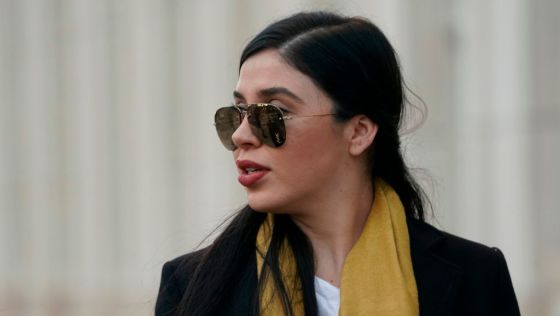
US-CRIME-MEXICO-DRUGS-CHAPO-TRIAL
DON EMMERT/AFP via Getty Images Emma Coronel Aispuro, wife of Joaquin “El Chapo” Guzman, departs the US Federal Courthouse February 4, 2019 in Brooklyn, New York.

After their wedding, she disappeared from public view until it was reported in 2011 that she had given birth to their twin daughters in Los Angeles County. On Feb. 22, 2014, she was with Guzmán and their daughters in the Pacific resort town of Mazatlan when he was captured by Mexican marines.

Guzmán was sent to the maximum security Altiplano prison outside Mexico City while his lawyers fought his extradition. On July 11, 2015, Guzmán escaped through a milelong tunnel that had been dug to the shower in his cell.

In January 2016, Mexican marines recaptured Guzman in Los Mochis, Sinaloa. The next month, Coronel gave her first ever interview to Hernández, complaining repeatedly about the conditions in which Guzmán was being held.

Coronel told Hernández she had learned of his escape from the Altiplano prison from television.

“If I had known something I wouldn’t have been able to sleep or eat from desperation,” she said. “I had no idea.”

Guzmán was extradited to the United States — but not before Coronel was involved in planning yet another escape attempt that never came to fruition, U.S. prosecutors say.

Coronel and her designer wardrobe made a splash at the El Chapo trial. Photographers elbowed each other to capture her arrivals and departures.

At one point, she wore a burgundy velvet blazer that matched one she had sent to Guzmán to wear that day. Afterward, she commissioned a courtroom artist to recreate the show of solidarity — a souvenir.

Coronel strode the courtroom confidently. She played with her hair while waiting for proceedings to start and chatted amicably with reporters sitting behind her. She carried crackers and cookies in her purse, sometimes offering snacks to reporters.

Every morning, Guzmán sought her out as he entered the courtroom. He smiled and waved hello.

One day she chatted and laughed in the courtroom with Mexican actor Alejandro Edda, who played Guzmán in the Netflix series “Narcos: México.” In the trial’s sixth week, she brought her 7-year-old twin daughters, dressed in matching jeans and white jackets; their father clapped to them softly, as if to play with them.

After Guzmán was convicted — he would be sent away for life plus 30 years — Coronel posted a statement thanking Guzmán’s attorneys, and her mother and sister for taking care of the twins while she was attending the trial.

She said the trial had been difficult. Her name had come up in testimony: Dámaso López, one of Guzmán’s former lieutenants, testified that he met several times with Coronel and Guzman’s sons to plan the drug boss’ escape from the Altiplano prison. And he said Coronel had relayed messages from her husband.

Coronel was unrepentant. “What I can only say about that is that I have nothing to be ashamed of,” she wrote. “I am not perfect but I consider myself a good human being and I have never hurt anyone intentionally.”

Emma Coronel has a huge following on Instagram

López, the editor of Noroeste, and Ismael Bojórquez, editor of Riodoce, a news outlet known for its investigations into Sinaloa’s underworld, both expressed shock that Coronel had traveled to and from the U.S. after the trial.

Hernández suspects U.S. authorities noticed Coronel’s change in lifestyle and spotted an opportunity to pressure her at a moment when she may be more open to betraying her husband.

Although Coronel has posted only five photos on Instagram (@therealemmacoronel), she has more than 563,000 followers.

For her last photo, posted in December, she posed in a white wedding dress, part of a fashion collection. And for a photo posted on her July birthday, she was resplendent in red lipstick, a black leather jacket — and a crown in her long, dark hair, an echo of the small-town beauty queen she was so long ago.

“Happy birthday to me,” she wrote.

____

Torrens reported from New York and Sherman from Mexico City. AP writers Tom Hays in New York and E. Eduardo Castillo in Mexico City contributed to this report.

Comments

Popular posts from this blog

New top story from Time: How 3 Key In the Heights Scenes Were Reimagined From Stage to Screen

https://ift.tt/3iIBhAh When director Jon M. Chu first saw the musical In the Heights on Broadway in 2008, his imagination whirred to life with possibilities. “Imagine if this was in a tunnel and the tunnel lights up?” he remembers thinking while sitting in the theater. “Imagine if you could look through a window of somebody dreaming, and the community could be reflected in the reflection?” More than a decade later, Chu is bringing these reveries to life as the director of the musical’s film adaptation, which arrived in theaters and on HBO Max on June 11. While other recent film-to-stage adaptations — like Ma Rainey’s Black Bottom and One Night in Miami — have leaned into the intimate, contained aesthetic of theatrical performances, Chu’s In the Heights has the ambition and scale of the most epic blockbuster films, complete with hundreds of extras and dancers, vibrant animated graphics, gravity-defying Fred Astaire-inspired dance numbers, and plenty of slick camerawork ...

US Capitol breached by Trump supporters, woman killed; Joe Biden says 'dark moment' https://ift.tt/3oo7Za2

In an "unprecedented assault" on democracy in America, thousands of angry supporters of President Donald Trump stormed the US Capitol and clashed with police, resulting in casualty and multiple injuries and interrupting a constitutional process to affirm Joe Biden's victory in the presidential election.

'Situation not normal, don't lower guard': Delhi's 1st COVID patient cautions people https://ift.tt/35GmCxs

As many continue to take leeway during the festive season, Delhi's coronavirus patient has cautioned people to stay indoors as much as possible because "situation is not back to normal". Rohit Datta, who was diagnosed with the infection on March 1, appealed to the masses to "not lower guard" by getting into a casual festive mode. 

New top story from Time: The Security Perimeter Around the Capitol Starts to Recede — and Washington Feels a Little More Normal

https://ift.tt/3ssgaEo This article is part of the The DC Brief, TIME’s politics newsletter. Sign up here to get stories like this sent to your inbox every weekday. Washington isn’t a city particularly known for its rationality. We do overreaction better than most, and that talent is rivaled only by underreaction. Passions fuel far too much public policy, personalities dictate what is possible and personal relationships often triumph over pragmatism. It’s something I usually bemoan and curse under my breath — or, increasingly, in this newsletter. So you’ll forgive a moment of indulgent irrationality and some merriment. For, you see, the fencing around the U.S. Capitol has come down. Well, not all of it. And the barriers that remain don’t have an expiration date and may never get one. But at least some of the garish barricades that went up in response to the deadly failed insurrection on Capitol Hill on Jan. 6 have been dismantled. The razor-wire on its top is gone, too...

New top story from Time: Our Eyes on the Virus: Why We Still Need Widespread Rapid Testing Even With Vaccines

https://ift.tt/3i5MoTN The vaccines are here. Why do we still need testing? Testing is our eye on the virus. Without testing, we can’t see where it is or where it is going. As fall and winter set in, outbreaks will again occur, sparked by the unvaccinated. And most people become infectious before they know they are infected. Frequent and accessible rapid testing is a tool that if deployed last summer and fall would have saved 100,000 lives. The U.S. missed the opportunity to use frequent rapid testing to stop individuals from unintentionally spreading the lethal SARS-CoV-2 virus to our most vulnerable and avert the horrific winter surge. By rapid tests, I mean the tests that an individual can conduct without a laboratory (ideally in the privacy of their own home) with results given in real-time. There are two types: rapid antigen tests, which look for the virus’s proteins and detect infectious levels of virus. The other lets you know you’ve been infected: rapid molecular...

FOX NEWS: Toddler admitted into American Mensa has an IQ of 146, makes history as youngest member A 2-year-old girl has just made history as the youngest member of American Mensa.

Toddler admitted into American Mensa has an IQ of 146, makes history as youngest member A 2-year-old girl has just made history as the youngest member of American Mensa. via FOX NEWS https://ift.tt/3yHFGc7

New top story from Time: Germany Has Officially Recognized Colonial-Era Atrocities in Namibia. But For Some, Reconciliation Is a Long Way Off

https://ift.tt/3fVRkaO The German government formally recognized colonial-era atrocities against the Herero and Nama people in modern-day Namibia for the first time, referring to the early 20th century massacres as “genocide” on Friday and pledging to pay a “ gesture to recognize the immense suffering inflicted.” “In light of the historical and moral responsibility of Germany, we will ask Namibia and the descendants of the victims for forgiveness,” said German Foreign Minister Heiko Maas in a statement , adding that the German government will fund projects related to “reconstruction and the development” of Namibia amounting to €1.1 billion ($1.3 billion). The sum will be paid out over 30 years and must primarily benefit the descendants of the Herero and Nama, Agence France-Presse reported . [time-brightcove not-tgx=”true”] Although it’s a significant step for a once colonial power to agree such a deal with a former colony, there’s skepticism among some experts and ob...

New top story from Time: The Most Powerful Court in the U.S. is About to Decide the Fate of the Most Vulnerable Children

https://ift.tt/34relNF When child custody cases come before family courts, judges endeavor to base their rulings on the best interests of the child. Overall, the court is less interested in which parent might have the most right to the children than in how best to help the children thrive. The Supreme Court might now be walking a very similar line. It is on the verge of deciding a landmark case that could have a profound impact on the more than 400,000 vulnerable children who find themselves in the U.S. foster care system. Its ruling could also have major implications for LGBTQ rights, religious liberty and nondiscrimination laws across America. [time-brightcove not-tgx=”true”] The case, Fulton v. City of Philadelphia , was sparked when the city said it would no longer contract with a faith-based agency, Catholic Social Services (CSS), to provide foster services after a 2018 Philadelphia Inquirer article revealed that it would not certify same-sex couples to be foster pare...

New top story from Time: 2021 Could Be the Biggest Wedding Year Ever. But Are Guests Ready to Gather?

https://ift.tt/3wC3WKU I was supposed to get married in September. Well, technically, as my husband would be quick to correct me, I did get legally married in September 2020 in the courtyard of our New York City apartment building in front of our parents, a handful of friends who lived nearby and a naked guy standing in the window of the building next door, who, I am told, cheered when we recessed. The 13 people in attendance wore masks I’d ordered with our wedding date printed on them, sat in distanced lawn chairs and sipped gazpacho I’d blended and individually bottled that morning in a frenzy of health-safety panic. [time-brightcove not-tgx=”true”] This was not the wedding of 220 people that we had originally planned. A few months into the pandemic, we made the call to delay our big celebration until 2021. We were hardly alone. In a typical year, Americans throw 2 million weddings, according to wedding website the Knot. Last year, about 1 million couples in the U.S. post...

New top story from Time: Constance Wu and Jenny Han on the Power of Inclusive Storytelling

https://ift.tt/3wFvLCm In conversation with senior editor Lucy Feldman as part of TIME’s “Uplifting AAPI Voices” summit , actor Constance Wu and To All the Boys I’ve Loved Before author Jenny Han discussed their groundbreaking work both in front of and behind the camera, the need for nuanced Asian American and Pacific Islander (AAPI) representation and their love for a good rom-com. TIME: When the film adaptations of Crazy Rich Asians and To All the Boys I’ve Loved Before first came out, there was a whole generation of Asian Americans who had never seen ourselves reflected like that. What did those films mean to you? And how did they change things? [time-brightcove not-tgx=”true”] Wu: I was in a unique position, having that happen to me with two big-profile projects: first there was Fresh Off the Boat, which was seeing yourself represented on network American TV. That was something that really hadn’t happened in a long time. Crazy Rich Asians was on a bigger sc...