New top story from Time: How Jin Liqun Charted an Independent Course for China’s Asian Infrastructure Development Bank
Born two years before Mao Zedong’s Communist Revolution, Jin Liqun was “sent down” by the party to help rural peasantry as a young man, and spent his teens farming paddy rice, wheat and cotton in the sunbaked countryside. In the evenings, he volunteered to keep the village accounts in a thatched hut by kerosene-lamp—a job which allowed him to indulge his passion of reading whatever dogeared Chinese and foreign texts he could procure. It was a “character-building” experience that set him on path to becoming president of the Asian Infrastructure Investment Bank (AIIB), Jin says. “It gave me the experience of understanding rural people’s dreams, aspirations, their hardships, their challenges.”
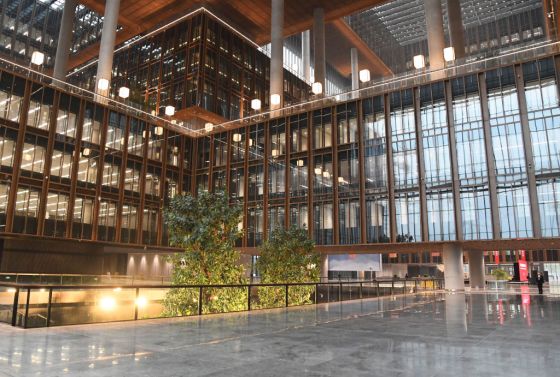
Jin, who has led the multilateral development bank since it was founded in 2015 with a remit to boost infrastructure across Asia and beyond, began his second leadership term on Jan. 16. His current workplace couldn’t be more different to the farmland of his youth. The AIIB’s yawning headquarters in Beijing’s Olympic Park, a stone’s throw from the celebrated Bird’s Nest Stadium, is modeled on northern China’s traditional courtyard homes. Each of the five interlocking buildings feature staggered indoor oases, meandering skywalks and a glass-topped central atrium that helps naturally regulate the inner climate. A 200-ton boulder from China’s sacred Taishan mountain occupies pride of place in the entranceway, meant to signify strong foundations, growth and stability.
As surroundings go, it’s not a bad place to wait out the pandemic, and the building reflects Jin’s favorite mantra of “lean, clean and green.” It also helps take the sting out of Jin’s enforced transition from jet-set to office-bound. Though, to believe the banker, it’s not an unwelcome switch. “I don’t abhor travel, but I enjoy working in my office,” the 71-year-old tells TIME in an exclusive interview. “Claustrophobia is never a problem for me; I’ve tried to develop the capability to work in a capsule flying through space for months without ever being bored.”
It helps, of course, that while Jin’s physical horizons have narrowed since COVID-19 cut a swathe across the globe, his workload has swelled to meet the challenge. The AIIB quickly pivoted last year to embrace pandemic relief, allocating $7 billion out of a $13 billion coronavirus war chest to help its members fight the virus. This translates to projects like giving loans for small businesses in Ecuador and Bangladesh; injecting liquidity into the cash-strapped economies of Turkey, Fiji and Uzbekistan; and bailing out tourism-reliant business in the Cook Islands.
“All of the sudden, there is a roadblock in front of us, as no countries had resources for infrastructure because they are fighting the pandemic,” says Jin. “So our management team came to the quick conclusion that we should respond to remove the roadblock.”
AIIB ‘should serve as a beacon’
It’s a nimbleness that characterizes Jin’s tenure. The bank was the brainchild of Chinese President Xi Jinping, who realizing that the World Bank and Asian Development Bank (ADB) were dominated by the U.S. and Japan respectively, sought a home-ground alternative to spotlight China’s growing presence on the world stage. Jin, who had served six-year roles in both the World Bank and ADB, as well as senior finance posts in Beijing, was tapped to run the new entity.
At its inception, however, the AIIB was perceived by the West as a funding mechanism for Xi’s signature Belt and Road Initiative (BRI), a trade and infrastructure network that started out tracing the ancient Silk Road, but has expanded to countries from Panama to Italy. The Obama Administration, for one, pooh-poohed the new bank and openly urged allies not to join. Under Jin, however, it has championed green initiatives and forged a path largely independent of Beijing’s soft power agenda, says Gregory Chin, associate professor of political science at York University in Canada, who studies the AIIB. Today, 103 nations are members including a slew of American allies. (Though still not the U.S. or Japan.)
“Anything new will be regarded with a soupçon of skepticism, just like a stranger strolling into a quiet neighborhood,” says Jin. “The most crucial thing, however, was transparency in every respect.”
Strict articles of agreements that mirror the rules of existing institutions helped assuage potential members that the AIIB was not a thinly veiled proxy for a Chinese development bank. The AIIB’s five vice-presidents hail from India, Indonesia, South Korea, Germany and the U.K. In addition, most projects are co-financed with either the ADB or World Bank.
“Beijing has its preferences and I’m sure Jin Liqun would be aware of them,” says Chin. “But I think he’s been very savvy and instrumental in fostering a multilateral culture and decision-making.”
To date, the bank—which has $100 billion capitalization, about two-thirds of the ABD or half the World Bank—has approved more than 100 diverse projects all over the world. These include $600 million for a gas pipeline in Azerbaijan, $216.5 million for slum modernizations in Indonesia, $60 million for a solar plant in Oman.
It is also obsessively progressive, committing to have 50% of financing directed to climate investments by 2025, and has never funded a single coal project—even turning down secondary coal-related infrastructure, such as roads or railways to coal mines or coal-fire powerplants. (The Belt-and-Road Initiative, by contrast, includes many such projects.) For Jin, “the bank should serve as a beacon, a lighthouse, giving signals to warn or guide ships in treacherous waters.”
From Red Guard to green guardian
Born in the eastern city of Suzhou, Jin briefly become a member of the Red Guards, the feared student-led paramilitary group that rose during the tumult of the Cultural Revolution in the 1960s, when higher learning establishments were shuttered.
When China’s universities eventually reopened, he was first in line and spent some time as a teacher. Then, in 1980, he moved to Washington, D.C. as a Chinese representative to the World Bank. In person, Jin is dapper, erudite and charming. His three-piece suit, plummy timbre and love of James Fenimore Cooper and Proust sets him apart from your typical CCP cadre.
He is, perhaps, how the Nixon Administration envisaged China’s governing elite would develop following China’s re-embrace by the global community: a cosmopolitan “communist” drilled by Das Kapital who now thrives within the international order. Put on the spot, such as being quizzed about Beijing’s influence, he summons arcane idioms or literary quotes in riposte. “There’s a phrase in French: confidence goes away like a horse but comes back on foot,” he says. “When you lose people’s confidence it’s very hard to recover. You cannot talk people into believing you. Credibility has to be earned.”
Trust in China has been hard to come by in recent years. Under Xi, China has become embroiled in disputes with the U.S. and allies over trade, technology, the origins of COVID-19, the rolling back of freedoms in Hong Kong and the extrajudicial incarceration of over a million Uighur Muslims, among many other bugbears. Meanwhile, a new generation of “wolf warrior” diplomats peddle conspiracy theories and lash out at perceived affronts.
Yet while Chinese diplomats, students, journalists and companies have been caught in the crossfire between Washington and Beijing, the AIIB has escaped censure. Any lingering suspicions are “less about the bank itself and more about the geopolitical context at the moment,” says Ivan Rasmussen, an assistant professor of political science at NYU Shanghai. In fact, Jin may lead the only piece of Xi-era foreign diplomacy that is not routinely skewered in the West.
In this respect, he is swimming against the tide in China. Under Xi, the party has extended its talons into all organs of state, rendering Jin’s success at keeping the AIIB seemingly free of political interference all the more remarkable. “The bank was born with the birthmark of China because China proposed it,” says Jin, “but it’s been brought up deeply embedded in the international community.”
Although Jin is adamant of his institution’s impartiality, with English as the operating language and the U.S. dollar as currency of implementation, China retains 60% of the voting rights of the bank. That LEED Platinum-rated headquarters belongs to the Chinese state. Xi gave the keynote speech at the bank’s fifth annual meeting in June, when he gave four edicts for the bank’s future direction. “Let us stay open and inclusive and make the AIIB a new paradigm of multilateral cooperation,” Xi said.
So far, this has not caused any real controversy. And as more nations join, Jin says that China’s de facto veto power may someday wither away. Yet many remain uneasy. What, for example, if a nation that doesn’t have diplomatic ties with Beijing — such as Paraguay or El Salvador, which instead recognize Taipei—wanted to join the AIIB?
“We do not reject any country which does not have diplomatic ties with China or any other country,” shrugs Jin. “As long as any country honors the articles of agreement there is no reason to reject them. But the approval is based on consensus. We don’t want this bank to be involved in bilateral politics.”
The post-COVID-19 challenge
While the AIIB has pivoted to address the pandemic, Jin says normal business will resume once the crisis is averted. Though, he is the first to highlight the many unanswered questions that will define the post-pandemic era. Will governments be shaken out of climate change complacency, or will economic pressures mean emissions continue to dangerously rise? Will international trade support development, or will protectionism and pandemic travel restrictions become a drag on growth? Will economies become more inclusive, or will inequality and disillusionment swell?
What Jin says is clear is that the infrastructure of 20 years ago will no longer cut it today. While ports, railways and powerplants remain important, there should be a renewed focus on telemedicine, AI-enabled diagnostics services and apps that can boost access to public health care systems for low income or remote populations. Digital hospital management systems, healthcare records and AI expert systems can lower costs while improving effectiveness. Still, 2.4 billion people currently do not have Internet access in Asia, where the number of seniors is forecast to double to 800 million in 20 years’ time.
Read more: How the Coronavirus Is Helping to Fix China’s Broken Healthcare System
“My perspective is it has never been so clear that international cooperation is crucial,” says Jin, “and never has such cooperation proven so effective and so productive.”
The AIIB recently approved $150 million on an orbiting satellite for Indonesia to bring broadband Internet to 149,000 public service points across its many remote islands. Apart from benefiting schools, family homes and businesses, the project can empower tele-medicine services to enable online pre-counseling sessions with a doctor to determine whether hospital treatment is necessary. “For the elderly or those with financial or mobility issues, this can be a game changer in terms of health service access,” says Jin.
This, says Jin, is the true work of the AIIB—far removed from the geopolitical wrangling. “When people look back on my tenure, if they say that AIIB was designed and built well, invested in high quality projects and helped nudge development practices into the 21st century, then I will be quite content with that legacy.” However, Jin does expect anyone to take him at his word: “The proof will be in the pudding, as they say.”

Comments
Post a Comment