
New top story from Time: I’m a Councilman in the Least Affordable Region in the U.S. Here’s How We Can Fix the Housing Market

https://ift.tt/3DdF4xm

Not long ago, I texted one of my constituents—someone who was deeply engaged in his community—to let him know about an upcoming debate for an issue on which he’d been a vocal leader.

Sorry, he texted back, he had actually moved out of the region a few months ago. Sadly, I wasn’t surprised. In the short months since being elected, nearly all of the young volunteers who had pitched in to help my campaign had either moved out of the region or were in the process of doing so. These were people invested in their community’s issues, who were forced to make a choice between staying and affording a home.
[time-brightcove not-tgx=”true”]

Campbell, Calif., where I serve, is part of the San Jose metro region, the most unaffordable housing market in the entire United States. I grew up here and experienced housing insecurity myself—my childhood family home was lost to foreclosure—so I’ve made housing a central focus. The pandemic has sharpened the inequality in the housing market, with single-unit prices in the Bay Area reaching their highest ever and tenants across the country facing an eviction crisis.

The problem is worsening nationally, but new research is increasingly clear on a solution that can be implemented locally: just build more housing.

While rising construction costs in labor and raw materials play a role in runaway housing costs, the major contribution is simply supply and demand. In a market as supply-constrained as housing, new construction—not just “affordable” but also market-rate units—helps to stabilize prices at both the metro-level area as well as in the immediate vicinity of new developments, as shown in a new UCLA study. “At the heart of this is the fact that we have just failed to build enough housing for a growing population over a period of decades,” says Shane Phillips, researcher on the study and author of The Affordable City, “and it’s only getting worse.”

Unfortunately, local city councils, which set housing standards through zoning ordinances, often impede new construction. Even when projects are approved, they are rarely built to the maximum density allowed and often downsized as the project progresses, often in response to the concerns of the most vocal residents. Many people who live in neighborhoods with single-family homes don’t want to see an apartment building or development go up in their area. But constraining supply in this way is precisely what has led to the exorbitantly high home prices we see today.

Nationally, 75% of residential land is zoned for single-family homes, limiting the amount of new housing that can be built to one house per parcel, and often with additional requirements for yard size and parking. In San Jose, that number rises to 94%, meaning that in one of the most prosperous regions of the country, it is illegal to build the vast majority of housing—anything larger than a single-family home. In some cities such as San Francisco, the appeals process is especially burdensome, with residents able to slow proposed projects down for years. With these kinds of restrictions on housing in place at the local level, construction costs will be higher. “It has become much more difficult to build housing,” Conor Dougherty, author of Golden Gates: The Housing Crisis and a Reckoning for the American Dream, says, “and as a result we have less housing—and the housing that we do build is more expensive.”
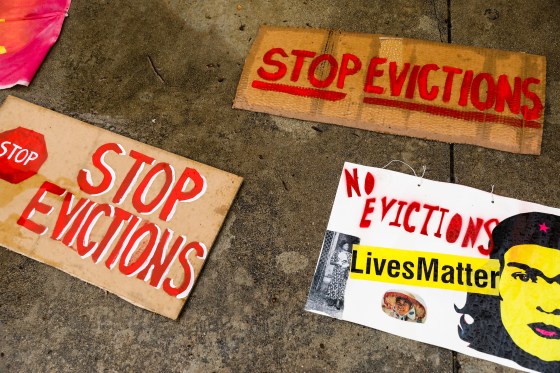
Signage lays on the ground during a protest outside the Santa Clara County Courthouse in San Jose to halt eviction proceedings from taking place on Jan. 27. Although rent moratoriums were instituted to help people who lost their jobs due to coronavirus shutdowns, certain types of eviction actions are still going forward.
Gabrielle Lurie—The San Francisco Chronicle/Getty ImagesSignage lays on the ground during a protest outside the Santa Clara County Courthouse in San Jose to halt eviction proceedings from taking place on Jan. 27. Although rent moratoriums were instituted to help people who lost their jobs due to coronavirus shutdowns, certain types of eviction actions are still going forward.

The societal costs of a national crisis in housing affordability are high—the risk of locking entire segments of the population out of homeownership. It’s a concern I hear consistently from constituents, and it’s borne out by the data. A report this year by the Urban Institute predicted that at current rates, homeownership in 2040 would fall to levels not seen since 1960, with losses concentrated among young people and Black households.

​​In fact, the origins of single-family zoning and other discriminatory zoning practices are pernicious and reach back decades. Historian Richard Rothstein, who has documented the racialized systems which shaped the American housing market, writes that “a series of racially explicit laws, regulations, and government practices combined to create a nationwide system of urban ghettoes, surrounded by white suburbs” — patterns which often persist today through the legacy of single-family zoning practices. As the population grows, Rothstein writes, restrictions on housing at the local level continue to reinforce this historic segregation.

With homeownership in America a primary means of building wealth, housing unaffordability therefore contributes to income inequality more broadly, resulting in an increased gap between those who can afford to buy and those who cannot—a dynamic which, in a feedback loop, fuels the affordability crisis. “We have seen a growing inequality and a bifurcation in the economy,” says Dougherty.

Data from real estate sales shows that in April of 2021, housing prices in the nine-county Bay Area were the highest in history. According to Dave Walsh, president of the California Association of Realtors, “the share of homes sold above asking price, the price per square foot and the sales-to-list price [are] all at record highs, while active listings remain at historic lows.”

But while housing is regulated by city councils and county governments, the implications of failing to build in one place, like California, are exported to the rest of the country. Predictions that the pandemic would bring the rise of telecommuting and thereby alleviate housing pressures have not borne out, Dougherty says. Even for those who have moved, “it’s not like people are telecommuting from some farm somewhere. They are moving from San Francisco to Seattle, or to Portland, or to Austin … Boise, Idaho.” These metropolitan areas, in turn, are facing their own affordability crises. The slow pace of construction in the Bay Area has a spillover effect across the country.

My community is ground zero for the housing pressures other regions could soon be facing. But we don’t have to wait for federal action—this is a problem that can be solved locally.

Nationally, governmental regulations are responsible for 23.8% of the cost of housing on average, so streamlining red tape can help to significantly reduce prices. Additionally, Shane Phillips says, policy proposals to address the housing crisis must not just increase supply, but also stabilize the housing market and prices through policies such as social housing—putting more housing in public hands and thereby keeping it affordable. “There is a larger role for government to play at the federal, state, and local level … The more that we can take things off the private market, the more stable things will be,” he says.

Local city councils can address these problems without any changes in law, simply by creating an environment encouraging of new developments rather than slow-walking projects or demanding reductions in density. This can also mean loosening zoning restrictions to allow infill construction in more locations and by reducing the areas zoned for single-family housing. In my experience, many communities already have duplexes and triplexes next to single-family units—developments which were grandfathered in despite current zoning practices—demonstrating that these denser units can add to both the character and inclusivity of a community. Local residents can make a big difference in this process by supporting new developments—having their say in the process without working to impede the additional construction which allows for communities to grow and thrive.

I’ve experienced firsthand what it’s like to face housing insecurity—feeling unmoored and at risk of losing your ties to the community. As a child, I witnessed strangers touring a house that no longer legally belonged to my family. I felt the swirling feelings of confusion, panic, and guilt that envelop you as you scramble to find a new place to sleep at night. It’s a burden that too many of my constituents are facing.

But while housing is an urgent issue of national scope, the good news is that all residents of a community can have a major impact at the local level. Anyone can speak up at city councils in support of housing and less restrictive zoning practices, helping to ease our housing crisis and building welcoming communities for all of us.

Comments

Popular posts from this blog

'Not Joining BJP', Sachin Pilot clears the air amid speculations surrounding political future https://ift.tt/2DDIvTz

Sachin Pilot has reiterated that he is not joining BJP amid speculations surrounding his political future after he openly rebelled against the 'slavery' of the Congress high command. Pilot has reportedly told news agency ANI that he will not be joining BJP.  from IndiaTV: Google News Feed https://ift.tt/32mgY3o

FOX NEWS: Dog earns Guinness World Record for longest ears This dog can definitely hear it when people say he’s a good boy.

Dog earns Guinness World Record for longest ears This dog can definitely hear it when people say he’s a good boy. via FOX NEWS https://ift.tt/3zKc8tR

MLA hostel in Mumbai evacuated after bomb scare https://ift.tt/3n307dK

An MLA hostel in south Mumbai was evacuated after the city police received a phone call about a bomb being placed in the building, an official said on Tuesday. However, no bomb was found after a search in the premises and the phone call turned out to be a hoax, he said. The incident took place on Monday night when an unidentified person called the police, saying a bomb was placed inside the Akashvani MLA hostel, located near the state secretariat, the official said.

New top story from Time: In the Gently Moving Minari, a Korean Family Finds Home in America’s Heartland

https://ift.tt/3ksxkyn Most stories about immigrants adjusting to America take place in cities, environs where a newcomer may already have family or friends, or at least be able to find a community. The family in writer-director Lee Isaac Chung’s Minari takes a different route: Jacob and Monica (Steven Yeun and Yeri Han) have come to America from Korea to seek better opportunities—we don’t know much more than that. But we do learn that Jacob has a dream of growing things, of being a farmer. Jacob, Monica and their two young children, David and Anne (Alan Kim and Noel Cho), have lived for a time in California, but as the movie opens, we see them driving to what will be their new home: A blocky rectangle of a house propped on cinderblocks, adjacent to a stretch of land that looks like paradise to Jacob—but not to Monica. She says little at first, but her stern silence tells us what she’s thinking: Why have you brought us here? This is 1980s Arkansas; there may be a few Koreans ...

New top story from Time: To Build Back Better, Tax Ultra-Wealthy Families Like Ours

https://ift.tt/2Y1lvIB After a summer of speculation, the contours of the deal needed to pass President Joe Biden’s popular “Build Back Better” agenda are becoming clear. To win key votes , Congress will have to find fresh sources of revenue to match new spending. Fortunately, there is an economically sound, overwhelmingly popular path that the President is endorsing: requiring ultra-wealthy families like ours to pay more in taxes. Doing so would mean reforming a tax code that allows the wealthiest to build and maintain fortunes without paying their share in taxes. Ultra-wealthy families further reduce their tax burdens to a pittance by deferring sale of their appreciated assets, borrowing against those assets and structuring their charitable giving. From 2014 to 2018, America’s 25 wealthiest people amassed a combined $401 billion, but in some years paid zero federal income tax, according to ProPublica . The Biden Administration calculates that America’s richest 400 famil...

New top story from Time: Jasper Johns: “Dying While on Assignment Doesn’t Seem Like a Bad Idea”

https://ift.tt/39PD2WS Jasper Johns, possibly America’s most famous living artist and still plying his trade at 91, launches two retrospectives on Sept. 29; one at the Whitney Museum of American Art in New York City and the other at the Philadelphia Museum of Art . The exhibitions, known collectively as Mind/Mirror, illuminate the through lines of Johns’ large body of work: his fascination with such everyday symbols as numbers, targets, maps and flags; his sometime habit of limiting his color palette to red, blue, yellow and orange; and his exploration of such techniques as collage, hatching and scale. One section of the Whitney is dedicated to his variations on the motif of a Savarin coffee can crammed with brushes, which is widely believed to be the artist’s way of representing himself. Johns, who famously destroyed all his prior work before painting his first flag, lives in Connecticut and rarely gives interviews. He answered questions from TIME via email. [time-brightco...

New top story from Time: The Overlapping Worlds of Author Amor Towles

https://ift.tt/3AUkxMM Amor Towles had never actually been beneath the vaulted ceiling of an Adirondack lake house when he described the one in his 2011 debut, the best-selling Rules of Civility . He could only imagine the appeal of such an exalted communal space—“this great room where the family gathers”—until, while shopping for a second home with the money from that book, he found himself touring a property an hour and a half north of Manhattan. “I was like, This is it!” says Towles, throwing his arms toward a 30-ft. ceiling that, like the glistening lake outside, now belongs entirely to him. “It was this weird thing where I was kind of buying the living room that I had written about,” he says. “Which, in a Stephen King novel, would end badly.” [time-brightcove not-tgx=”true”] In the storybook life of Amor Towles, however, the new owner lays down thick Oriental rugs (thicker still where they overlap), sets his laptop on a long oval table by floor-to-ceiling windows and—...

New top story from Time: Here’s What We Learned From Three New Britney Spears Documentaries, From Secret Surveillance to #FreeBritney Infiltrators

https://ift.tt/3m9avBb A flurry of new documentaries centered on Britney Spears and her court-ordered conservatorship have shed more light on the immense hardship that Britney has faced over the course of the 13-year legal arrangement. The three specials—FX and the New York Times’ Controlling Britney Spears , CNN’s Toxic: Britney Spears ‘ Battle for Freedom and Netflix’s Britney Vs Spears —were all released in the week leading up to Britney’s highly anticipated Sept. 29 court date, a hearing at which Los Angeles County Superior Court Judge Brenda Penny is expected to address Britney’s petitions to remove her father, Jamie Spears, as conservator and terminate the conservatorship as well as Jamie’s own unexpected petition to end the arrangement . [time-brightcove not-tgx=”true”] Attention surrounding the hearing and the fan-driven #FreeBritney movement has continued to ramp up in recent days as reports of shocking new details regarding Britney’s case, as alleged by t...

New top story from Time: Atlanta’s First Black Female District Attorney Is at the Center of America’s Converging Crises

https://ift.tt/2Y1oy3U So much of what is ugly and unhinged about America can be seen in the eyes of a mother whose 8-year-old is dead. But, on a Tuesday in August, at Atlanta’s downtown courthouse, that’s where Fulton County, Ga.’s district attorney, Fani Willis, is looking. She’s meeting with Charmaine Turner and Secoriey Williamson, the parents of Secoriea Turner , a chubby-cheeked Black girl with generous eyebrows, who liked to make TikTok dance videos and throw up peace signs in candid pictures. A bullet pierced her back and killed her last year after she attended a Fourth of July fireworks show. Secoriea’s killing was random, but part of a larger story. On June 12, 2020, an Atlanta police officer fatally shot Rayshard Brooks in the parking lot of a Wendy’s, setting off protests. By Independence Day, armed men—whom Willis takes pains to distinguish from protesters—had erected barricades nearby. It has since become public knowledge that city officials appear to have direc...

New top story from Time: The Rolling Stones Open Their American Tour, Paying Tribute to Drummer Charlie Watts

https://ift.tt/3o7cVTy ST. LOUIS — The Rolling Stones are touring again, this time without their heartbeat, or at least their backbeat. The legendary rockers launched their pandemic-delayed “No Filter” tour Sunday at the Dome at America’s Center in St. Louis without their drummer of nearly six decades. It was clear from the outset just how much the band members — and the fans — missed Charlie Watts, who died last month at age 80. Except for a private show in Massachusetts last week, the St. Louis concert was their first since Watts’ death. The show opened with an empty stage and only a drumbeat, with photos of Watts flashing on the video board. After the second song, a rousing rendition of “It’s Only Rock ‘N’ Roll (But I Like It),” Mick Jagger, Keith Richards and Ronnie Wood came to the front of the stage. Jagger and Richards clasped hands as they thanked fans for the outpouring of support and love for Watts. Jagger acknowledged it was emotional seeing the photos of Watts....