New top story from Time: Sesame Workshop Is Talking More Explicitly About Race—and Welcoming Two Black Muppets
Bradley Freeman Jr. was doing some Christmas shopping at Target when he got the email. Glancing down at his phone, all he could see was a preview: “Hey Brad, thanks for taking the time to audition for us …” He immediately assumed he had been rejected.
Then he read the rest.
“I had to read it over, like, seven different times to make sure that I actually got the part,” he says. “I say yes, and then I realized I didn’t actually type anything so I had to send a second email and say yes and then texted—I was like, ‘Just making sure you know that I accepted this part.'”
The part—the one that had him “hyperventilating in the middle of Target”—is the puppeteer for Wesley Walker, a new Black Muppet who, along with his father Elijah, will be introduced on March 23 by Sesame Workshop, the nonprofit behind Sesame Street. “To actually, fully believe that I have my own original, brand-new character on the show is not something that I can really accept,” Freeman says.
Since Sesame Street debuted more than five decades ago, in 1969, the show and the nonprofit’s related programming have dealt with tough topics in an age-appropriate way. When actor Will Lee, who played Mr. Hooper, died in 1982, producers decided not to simply tell viewers he had gone away—instead they built an episode around death and grief. “We were advised to take the direct approach,” Valeria Lovelace, the show’s former director of research, told the Associated Press at the time. “Children don’t understand words like passing away.” In 2002, Takalani Sesame, the South African version of Sesame Street, introduced Kami, a 5-year-old HIV-positive Muppet, who was an orphan. More recently, the organization has created Muppets who can help broach other difficult subjects through its Sesame Street in Communities initiative, which provides materials and media for kids in a wide range of situations. Lily, who made her debut in 2011, struggled with food and housing insecurity. Karli, who was introduced in 2019, was in foster care and had a mother who struggled with addiction. Julia, a Muppet with autism, first appeared in a digital storybook in 2015 before becoming a regular on the show in 2017.
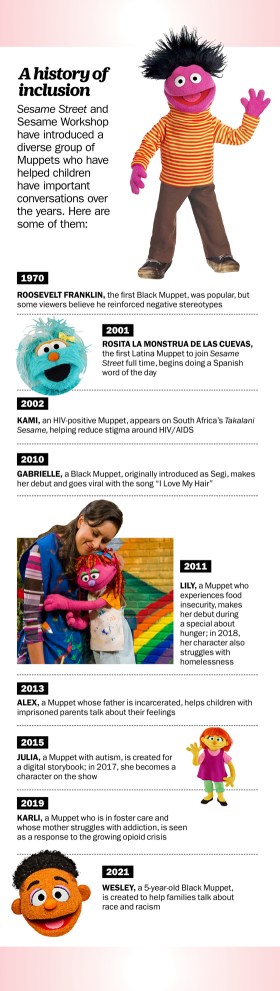
But while Sesame Workshop has always highlighted the importance of multiculturalism and inclusivity—and featured a racially and ethnically diverse human cast—it’s never really tackled race and racism head-on. In recent years, though, it’s become increasingly apparent how important it is to address these topics in early childhood. Studies have indicated that people can begin recognizing racial difference as infants, but a 2019 study by Sesame Workshop, conducted in partnership with the social-research organization NORC at the University of Chicago, found that many parents rarely or never discuss race or ethnicity with their kids.
The decision to give Wes and Elijah a racial identity—and to have them talk about what it’s like to be Black in America—represents a marked shift in approach. “After last summer with the racial unrest that happened and the murder of George Floyd, we collectively as an organization decided that the only way that we could go about dismantling racism was by being bold and explicit,” says Kay Wilson Stallings, the executive vice president of creative and production for Sesame Workshop. “People were working remotely. People were feeling a lot of emotions, and it was almost like everyone had the same realization. If not Sesame, who’s going to address this? It felt like everyone had the same, ‘Yes, we’ve got to do something about it, and the first way to address it is that we need to define racism for 3-year-olds.'”
As a result, Sesame Workshop and its team of educational advisers developed Coming Together, a racial-justice initiative with an educational framework and curriculum, which in the eight months since it launched has included a town hall with CNN about racism and protest, as well as a special, The Power of We, about speaking out against systemic inequality and prejudice. In one viral clip from the June town hall, Elmo’s dad Louie explains the demonstrations Elmo has been seeing outside his window: “On Sesame Street, we all love and respect one another. Across the country, people of color, especially in the Black community, are being treated unfairly because of how they look, their culture, race and who they are. What we are seeing is people saying enough is enough. They want to end racism.”
Now it is launching a set of resources it’s calling the ABCs of Racial Literacy, with the aim of giving children, parents and educators the language and tools to talk more openly about race and racism. It is the latest addition to Coming Together, and another sign that the organization is making this subject matter a more integrated part of the programming and curriculum. Jeanette Betancourt, the senior vice president of U.S. social impact for Sesame Workshop, who has worked there nearly 30 years, says it’s a logical step in its evolution. “It’s not necessarily taking a risk but meeting a demand that we know we need to meet,” she says.
“Elmo has a question,” Elmo says. In one of the new racial-literacy videos, he has just observed that a red leaf is similar in color to his fur and a brown leaf is similar in color to his friend Wes’ skin. “Elmo wants to know why Wes’ skin is brown.”
“I know why, Elmo, my mom and dad told me. It’s because of melanin,” says Wes proudly, before turning to Elijah. “Right, Dad?”
Elijah’s response is exactly what anyone familiar with the Sesame Workshop would expect: straightforward, clear and age-appropriate, with no hint of discomfort, no attempt to dodge. “It’s not that it’s different,” says Louis Henry Mitchell, Sesame Workshop’s creative director of character design. “It’s just that now we have an opportunity to turn up the volume of what we’ve already been doing.” The scene also illustrates why it was important for the organization to create a father-son duo: it wanted model conversations between a child and a parent, not just between friends like Elmo and Wes.
In the video, Elijah agrees with his son, before diving into an explainer of how melanin determines skin, hair and eye color. “The color of our skin is an important part of who we are, but we should all know that it’s O.K. that we all look different in so very many ways,” he says.
Betancourt says it was a deliberate choice to make Elijah and Wes “humanoid” Muppets with realistic skin tones, so they could address the physicality of race. (By contrast, Sesame Street’s first Black Muppet, Roosevelt Franklin, who appeared on the show from 1970 to 1975, was purple.) But while the creative team didn’t want to shy away from race—it’s an important part of one’s identity—they also wanted to teach young viewers that it’s not the only thing that defines them.
“It’s not just that they are Black Muppets; they’re built as a family,” Betancourt says. “There’s a backstory for them and their personalities. What we really look at is, What is the identity of our Muppets? What are their characteristics? What is their personality and their self-identity?” Elijah, for instance, a 35-year-old meteorologist, loves running, being outdoors, watching movies and cooking with his family. Wes, who’s 5, loves going to school and playing pretend with his friends. (Wes’ mom Naomi is currently in development.)
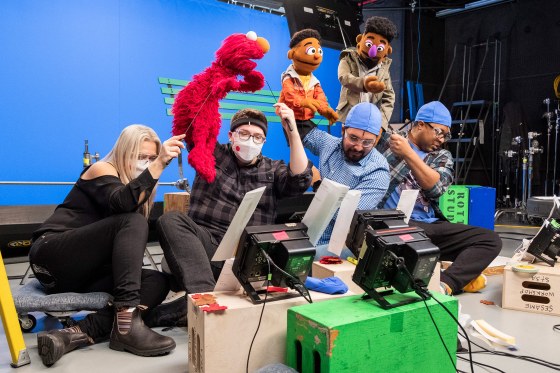
“He’s very imaginative, he’s very fun,” Freeman says of Wes. “He’s always trying to help his friends and make sure that they feel safe and that they feel loved and that they can feel strong in their own skin. The more I perform him, the more I get to know him. Sometimes he gets a little lost in his own emotions because he comes from a family that’s very big on communicating how they feel—he’s able to communicate, but he’s also 5 years old. So sometimes things overwhelm him, and he can be angry or sad. So that’s where he really relies on his dad and his friends to make sure that he can come to the best solution possible.”
Mitchell, who sketched the new Muppets and cites his own son as an inspiration for Wes, says he didn’t base Elijah on himself but was able to bring “the spirit of fatherhood” to his work. Elijah’s puppeteer, Chris Thomas Hayes, too, has found a connection with the characters. “A lot of the things they wrote, I was looking around, like, ‘Are they watching me?’ Because it says there is a 5-year-old son; I have a 5-year-old son,” he says. “It’s really been a moment of thinking about the conversations and the situations that I’m going to be dealing with my kid being in this world. And that’s something I hope that I bring to the character.”
While the protests of 2020 faded all too quickly from many people’s minds, Sesame Workshop doesn’t consider the events of last summer merely a moment of reckoning. Even before Floyd was killed, Betancourt says, the nonprofit was thinking about programming around historical trauma and systemic racism. But the urgency around these issues became clear. “Our mission is, How do we continually respond? Respond quickly, respond boldly, but also in a way that does it easily. In other words, we open the door from a child’s point of view so that those conversations fit into everyday moments, or typical questions that children may be asking anyway.”
As part of the Coming Together initiative, Elijah and Wes will be joined by 6-year-old Gabrielle and her 8-year-old cousin Tamir, two other Black Muppets who also appeared in earlier broadcasts. (Gabrielle, once known as Segi, went viral about a decade ago singing a song called “I Love My Hair.”) In another new video, the ebullient teal monster Rosita, who has talked frequently about her Mexican identity and expressed her love for her abuela, confides in a friend about a racist incident she experienced while speaking Spanish in a grocery store. “Sometimes people who speak another language get treated unfairly,” her mother tells her, “but it doesn’t mean you have to stop being yourself.” Then they have a conversation about how to handle incidents like that in the future. Other resources, available for free in English and Spanish, include a new song that celebrates unique identities and documentaries about real families who share how identity and race shape their lives.
Calvin Gidney, an associate professor of child development at Tufts University, says he applauds Sesame Workshop for taking on this topic. “We’re at quite a cultural moment, and I’m glad that Sesame Street has chosen which side of that particular cultural war it wants to come down on,” he says. But he notes that if the organization really wants to confront structural racism, white characters must explore their own racialization too. “If it were just Black, Indigenous and people of color who have these discussions, then it would still perpetuate the idea that whiteness is not a racial category,” Gidney says. “It can sort of make whiteness absent in the conversation, whereas I think whiteness is at the center of the conversation. I think it’s super important that white families also learn how to model talking about race with their kids.” Sesame Workshop’s own study backs this up: only 26% of white parents said they were likely to discuss race and ethnicity with their children, compared with 61% of Black parents.
Wilson Stallings says they intend to speak to a wide audience with their racial-justice programming. “There are different approaches and different needs and different ways of bringing in the audience, whether you’re BIPOC or whether you’re not BIPOC,” she says, but they made a conscious decision that this work would focus initially on Black and brown communities, “because those are the folks that are most impacted with systemic racism.” She emphasizes that Sesame Workshop is making a long-term commitment to talking about these issues from all angles. “Multiyear, multiproperty, multiplatform,” says Wilson Stallings. “I’ve planned it out to 2024 for right now.”
In addition to the ABCs of Racial Literacy, the racial-justice programming will be part of Season 52 of Sesame Street, which will air in late 2021, and a focus of Season 53. The nonprofit will also be developing a framework for parents of infants to 2-year-olds, Wilson Stallings says, and they’d like to create content focused on racial justice for 6- to 8-year-olds. “Racial justice is now part of our DNA,” she says. “You can’t unsee.”
Hayes, Elijah’s puppeteer, says he is not surprised that Sesame Workshop would move in this direction given its history, and he hopes Wes and Elijah end up on the TV show too. “It is something very special to really come out and go, ‘These characters are African American or Black,'” he says. “I’m so proud of the company, and it makes me want to do all I can to help them do this message. Even though it does ruffle some feathers, it’s for the right reasons, because sometimes we have to ruffle feathers in order to be better than we were yesterday.”
This appears in the March 29, 2021 issue of TIME.

Comments
Post a Comment