New top story from Time: The House of Flowers Is Proof That Telenovelas Are Changing—and So Is the Way We Watch Them
Mexican director Manolo Caro didn’t think that his first series for Netflix, La Casa De Las Flores (The House of Flowers), would be a hit when it first appeared on the streaming service in August 2018. “But I was completely wrong,” he says of the dark comedy-drama that focuses on the lives, secrets and scandals of the wealthy de la Mora family in Mexico City. “[It] really changed my entire life.”
The Spanish-language series ended up becoming a global phenomenon, going on to air its final of three seasons last year. Although Netflix does not release viewing figures for individual shows, The House of Flowers received much attention in Latin American and English-language media, and has been extensively analyzed by academics and experts. The distinctively slow speaking style of one of its main characters, Paulina de la Mora (played by Caro’s frequent collaborator Cecilia Suárez), spawned a viral social media challenge and many memes in 2018.
[time-brightcove not-tgx=”true”]
Now, Caro is preparing for what he calls “a gift for the fandom” with the release of La Casa de las Flores: La Película, a new feature-length film building on the series, out on June 23. In the age of streaming services, Caro’s work points to the growing popularity of accessible Spanish-language series globally, made by local creators. “The common theme in my work is dark humor,” he says. “It’s important that the new generation knows how the idea of the telenovela has changed.” That change is a product of both social norms and technological shifts in the industry, resulting in the rise of what some have dubbed the “millennial telenovela,” often encompassing more progressive and inclusive ideas compared to its predecessors. And while the telenovela has been a hugely popular international genre for decades, the power of streaming services means the way in which audiences watch these shows has been radically transformed.
The House of Flowers and its telenovela roots
Lush interiors, fashionable styling and artistic flair are all hallmarks of The House of Flowers, based around the high-society de la Mora family and their flower shop and cabaret show, which both share the show’s title. That aesthetic comes partly from Caro’s training as an architect. “Architecture and the movies are very similar. Architecture is like storytelling,” he says, citing Spanish filmmaker Pedro Almodóvar, known for his flamboyant style and LGBTQ characters, as an inspiration. Throughout the series, we follow the three de la Mora siblings—Paulina, Elena and Julian—as they navigate financial difficulties, interracial relationships, their sexualities and long-held family secrets. The film picks up where the series left off, jumping between two interconnected timelines with the de la Mora siblings on a mission to reclaim a family treasure in the present, and their parents attempting to exact revenge on an enemy in the 1970s.
“I think people connected with The House of Flowers because everybody wants to have a perfect family and nobody has it,” says Caro, who signed a four-year deal with Netflix in 2019, putting him among fellow Mexican creators including Oscar-winning filmmaker Guillermo del Toro and animator Jorge Gutierrez in partnering with the platform. “The family is a very important topic for me, maybe because I have a very complicated family and I want to represent it in my shows.”
In The House of Flowers, the feminist themes and LGBTQ storylines were part of Caro’s vision from the beginning. He weaves these into the arcs of Julian de la Mora, who comes out as bisexual to his family during the series and by the time the film takes place is raising a baby with his partner Diego; and with The House of Flowers queer cabaret, which is hosted by trans women and drag queens. “I want to put visibility on these things,” says Caro, who is openly gay. “I grew up in a society where I never felt represented. I needed to change that.”

Breaking down the ‘millennial telenovela’ genre
While that emphasis on soap-opera style melodrama and dysfunctional family dynamics might be more typical of traditional telenovela series produced across Latin America, critics and academics have placed The House of Flowers, along with Ugly Betty (a remake of the Colombian telenovela Yo Soy Betty, La Fea), Jane the Virgin and Luis Miguel: The Series, among a newer subgenre: the “millennial telenovela.”
Telenovelas originated as radio programs in the 1930s and were adapted for the screen from the 1950s onwards, with the main production hubs historically located in Brazil, Mexico, Venezuela and Argentina, and more major producers in Chile, Colombia, Ecuador, Peru and Puerto Rico. They are an influential part of everyday culture across the region, with several different genres and geographically specific nuances. They also carry a great deal of meaning for Latino families and communities in the U.S.; as author Olga Segura wrote in 2018, “for immigrants like my parents, who arrived in the United States with nothing, telenovelas allowed them to feel connected to the countries and cultures they had left behind.”
But over the years, certain shows have been critiqued for sexism and racism ingrained in storylines reinforcing gender stereotypes. “With predominantly light-skinned female leads, telenovelas promote a Eurocentric idea of beauty,” Segura also wrote. “For most of the genre’s history, telenovelas have portrayed female protagonists as damsels in distress who require male saviors.”
“The House of Flowers should be recognized for normalizing formerly taboo topics surrounding gender and sexuality,” Juan Llamas-Rodriguez, assistant professor of critical media studies at the School of Arts, Technology and Emerging Communication at the University of Texas at Dallas tells TIME via email. While it’s not the first Mexican telenovela to include gay and transgender characters, “the fact that The House of Flowers’ LGBTQ characters have been allowed to have stories beyond their gender or sexual identities goes a long way towards moving such stories away from salacious content or ‘very special episodes,’” he says.
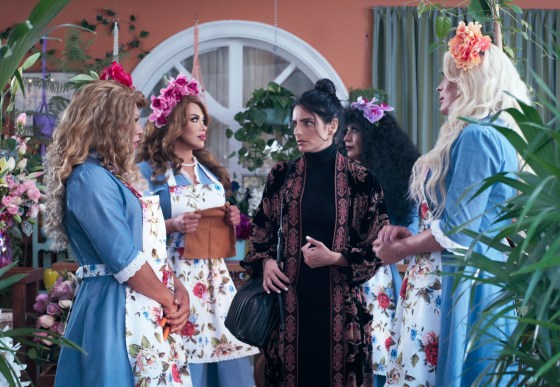
Yet Llamas-Rodriguez also points to the series’ limitations: the cast of characters is largely white and affluent, giving a limited representation of LGBTQ experiences in Mexico. And the casting of cisgender male actor Paco León as María José, a transgender woman, has also received criticism. Such casting decisions are not unprecedented, as seen through the history of transgender representation on screen in U.S. entertainment that have included hurtful depictions of trans stories and experiences. For Llamas-Rodriguez, these trends are “emblematic of the media industries’ more conservative tendencies. In that sense, I think The House of Flowers is a lot more traditional than its promotion makes it out to be.” He also points to major legacy broadcasters like Telemundo, who too have been adapting the format and narratives of their shows in recent years to attract new audiences.
Caro says he “loves” the millennial telenovela label The House of Flowers has garnered, as it suggests a fresh interpretation, appealing to many different and new audiences, of a genre that some might see as old-fashioned. “I want to invite people to say that it’s not bad to do a telenovela, it’s about putting new topics of social interest in the plot.”
An evolving global media landscape
Whereas Hollywood was once the primary exporter of stories around the world, recent years have seen global barriers rapidly eroding. Creators signed with streaming platforms have the freedom to explore new ideas with a great degree of autonomy. For Caro, that freedom was liberating, as he couldn’t envisage his work, tackling themes of feminism, LGBTQ issues and social hierarchies, gaining much traction with the major traditional broadcast networks in his home country. “We have to understand that [Mexican] society is still very closed,” he says. “Now these platforms give us the opportunity to feel complete freedom, and I can do whatever I want, with responsibility of course.”
It’s that kind of freedom that’s allowed Caro to experiment with a range of genres and formats beyond The House of Flowers, including last year’s limited series thriller set in Franco-era Spain Alguien Tiene Que Morir (Someone Has to Die) and his forthcoming project Érase Una Vez…Pero Ya No (Once Upon A Time…But Not Anymore), a musical series—Netflix’s first such project in the Spanish language, starring A Fantastic Woman’s Daniela Vega. The House of Flowers franchise also included a short film, set chronologically between seasons one and two, which converges from telenovelas’ traditional broadcast schedule of hour-long episodes during the work week. For Llamas-Rodriguez, changing consumption habits, including the ability to binge-watch shows on streaming platforms, “might be the most significant change from traditional telenovelas, which were known for being ‘a part of everyday life’ with their daily episodes and slow burning, months-long narratives.
Caro has also had the opportunity to work with actors from different Spanish-speaking countries, broadening the appeal of his work beyond Latin America to the U.S. and Spain, where Netflix’s first European production hub opened in Madrid in 2018. “It’s not just about The House of Flowers—it’s about Money Heist, Elite, Who Killed Sara?—it’s important to be part of this generation that makes the Spanish language travel around the world,” says Caro, referring to other hit Spanish-language series whose popularity has transcended borders.
Experts say this is part of a new and growing trend. Traditionally there was almost no crossover between Spain and Spanish-speaking audiences in the U.S. and Latin America, partly due to regional factors including different accents and speech styles, says Paul Julian Smith, professor of comparative literature at the City University of New York. “Latin American telenovelas are little seen in Spain,” Smith tells TIME via email. “Likewise, U.S. Latinx audiences watched mainly Mexican telenovelas on their networks and had no idea about TV from Spain in the past. The House of Flowers makes an explicit appeal from Mexico to Spain by casting Spanish actors and using Spanish locations.” He attributes this burgeoning “pan-national Spanish-speaking audience,” in part, to streaming platforms.
However, as Smith points out, free to air Spanish-language television in the U.S. through the Univision and Telemundo networks still reaches a broad audience, with traditional telenovelas and biographical series remaining popular and likely not crossing over to non-Spanish speakers. The New York Times also reported last year that viewing figures for telenovelas on broadcast networks in Mexico experienced a surge in viewership during the pandemic, signaling the enduring popularity of the traditional form.
Foreign-language series more generally are also a boon to the platform’s viewing figures—as seen with the global success of Lupin and Money Heist, coming in third and fourth in Netflix’s most-viewed original TV shows. Other services are taking note too—this month, HBO Max presents its first international expansion launching in Latin America, and in April, the streamer announced that it will develop more than 100 local productions across the region over the next two years, signaling a hefty investment and commitment.
For some experts, like Llamas-Rodriguez, a significant part of the success of The House of Flowers has been due to its appeal to “white, cosmopolitan sensibilities,” through its casting of almost exclusively white actors, actively referencing popular international entertainment including Desperate Housewives and Almodóvar films, and emphasizing its progressive storylines in promoting the series in marketing materials and social media. “The House of Flowers has enjoyed such popularity because it builds on the most appealing aspects of previous versions of the telenovela genre, but makes them palatable for an international audience that may not have been familiar with them before,” says Llamas-Rodriguez, who is writing a book on how this phenomenon recurs among Netflix Mexico’s most popular original productions.
For creators like Caro, the streaming wars’ battle for global audiences has resulted in international success, and near total creative freedom. “I want to entertain people,” he says. “It’s a pleasure for me to represent this generation in my country and my language and to travel around the world with my ideas. This is huge.”
Comments
Post a Comment