
New top story from Time: After His 2020 Death in a New York Jail Cell, Jamel Floyd’s Family File Lawsuit Against Bureau of Prisons

https://ift.tt/3xV8w7X

More than a year after his death, and with many of their questions still unanswered, the family of Jamel Floyd, a man who died in a New York City federal jail after being pepper-sprayed by guards, filed a lawsuit against the Bureau of Prisons (BOP) on June 23.

Floyd, 35, was being held at the Metropolitan Detention Center (MDC) in Brooklyn, and was just a few months away from parole eligibility. His death occurred just a week after George Floyd was killed by a police officer in Minneapolis and amid a larger reckoning on racial discrimination and violence at the hands of law enforcement.
[time-brightcove not-tgx=”true”]

With calls for accountability in these kinds of incidents still prevalent, Floyd’s family is fighting for their own justice—their suit asks that a case over his death is brought to trial.

Jamel Floyd with his mother, Donna Mays .
Courtesy of the Floyd FamilyJamel Floyd with his mother, Donna Mays, in an undated photo.

The Floyd family organized a protest in Brooklyn earlier this month calling for officials to be held accountable and for the much-criticized jail to be shut down. Although Floyd’s mother Donna Mays is grateful for the community’s support—and attended the June 3 event—she’s not able to be out on the streets as much as she used to. “I’ve had to slow down for my health. I’m not sleeping and it’s not a good thing,” she tells TIME. “It’s hard to go on with life. Every day, you think about this. It pops in your head every single day. No mother should have to bear that.”

Jamel Floyd’s father, James Floyd, isn’t getting much sleep either—usually no more than three hours a night. “I’m tossing and turning, thinking about my son frequently,” he says. “I pray that God answers my prayers and brings this [jail] down … down to the ground.

Read More: Momma’s Not Stopping Until That Jail Goes Down.’ The Family of Jamel Floyd, New York Man Who Died After Being Pepper Sprayed By Jail Guards, Speak Out

“Over the course of just a few days in late May and early June 2020, Mr. Floyd experienced first-hand the brutal treatment that has given the MDC Brooklyn its reputation,” the Floyd family’s lawsuit states. On May 29, just a few days before his death, Floyd was assaulted by correctional officers in the facility, the suit alleges, after he was searched in a bathroom and a contraband cellphone was discovered.

He had to be taken to an outside hospital to treat injuries he sustained during the incident, according to the lawsuit. Lawyers representing the family say he was then placed in solitary confinement pending a disciplinary hearing for the cellphone. (And since he had been to an outside hospital, he was required to quarantine in a specific section of the jail’s solitary unit due to COVID-19 protocols.)

The BOP did not respond to TIME’s request for comment on the lawsuit’s allegations.

On June 3—and while still being held in solitary—Floyd began experiencing a medical or mental health crisis in his cell. He spent hours pleading for help and broke his cell window, attempting to get someone’s attention.

“Instead of assisting Mr. Floyd, dozens of correctional officers flooded into the unit where Mr. Floyd was confined. Officers sprayed several canisters of pepper spray directly into his locked cell. This grossly excessive use of force caused Mr. Floyd to collapse and experience a [fatal] heart condition,” the lawsuit says. (Floyd’s cause of death has been listed as a heart attack.)

“Instead of helping him, [correctional officers] treated him like he was a threat,” Nick Bourland, a lawyer representing the family, tells TIME. “They never summoned medical assistance until it was way too late. This is someone who was dying in their arms.”

Bourland and Katie Rosenfeld, another attorney representing the family, have spent the last year trying to get details on the circumstances around Floyd’s death. But, they say, the BOP has not been cooperative. Though they have sourced some information, they believe much more is being held back on the grounds that it pertains to an internal investigation into Floyd’s death, which is still ongoing. The FBI has also completed its own investigation, the lawyers note.

Bourland says they even had to file a Freedom of Information Act Request (FOIA) to get Floyd’s prison medical records. “It is unheard of for a family to not get access to the deceased’s medical records. It’s harmful and hurtful,” Bourland says. “They had no reason to withhold them.”
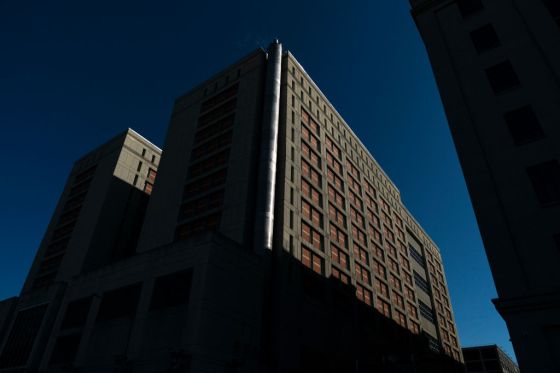
An exterior view of the Metropolitan Detention Center
Drew Angerer—Getty ImagesAn exterior view of the Metropolitan Detention Center on Feb. 4, 2019 in Brooklyn, New York.

The attorneys were able to see some security footage from the day of Floyd’s death, but it does not show what’s happening in his cell: “Most of what you see is people’s backs. You do see dozens of people respond to the scene. You see this massive response of people showing up with shields,” Rosenfeld explains.

It later shows Floyd being carried away in a restraint chair. “When the correctional officers called for a restraint chair, Mr. Floyd was neither violent nor out of control—he was unresponsive and experiencing a life-threatening cardiac emergency,” the lawsuit states.

None of the guards who approached Floyd in his cell had a handheld camera, though BOP policy states that this should have been the case. (Rosenfeld and Bourland say they have received no information as to why the policy was flouted.)

Read more: The Violence Against People Behind Bars That We Don’t See

Floyd’s death speaks to a larger issue within the criminal justice system, manifested in particular in the prison and jails. In public, it’s possible—albeit difficult—to monitor police behavior, with civilians able to serve as witnesses and document instances of misconduct or brutality.

This was the case in the murder of George Floyd, as then 17-year-old Darnella Frazier was able to film his death, while under arrest, on her cellphone. The footage completely discredited the Minneapolis Police Department’s account—which initially claimed that Floyd was suffering from a “medical incident”—of what happened.

But such oversight is near impossible in correctional facilities.

“Prisons are secretive places where things are made invisible because the people in power control what gets seen,” Rosenfeld says. “When [misconduct happens], there is no way for other people to intervene. It’s hard to get accountability and truth.”

The grief, both over Floyd’s death and that lack of accountability thereof, still feels raw for his family. Mays still visits her son’s grave at the cemetery two or three times a week. “It’s very exhausting,” she says. “You just don’t let go of a firstborn child. You gave them life, you gave them air and they took that away from you.”

Floyd’s sister, Tawanna Floyd, is struggling too. “It hurts me everyday. I try to keep my composure but I end up lashing out at people because I’m still angry inside,” she says. “I just miss him so much.”

And his brother Ramel Floyd says he tries to take the grief just “one day at a time.” Last month, he viewed the video footage from the time of Floyd’s death. “The reality of seeing it was definitely sad,” he says. “Watching it, you could just tell they did a lot of things they weren’t supposed to.”

Comments

Popular posts from this blog

Republic Day: 38 Delhi cops awarded police medal https://ift.tt/3sVo5uw

Thirty-eight Delhi Police personnel have been awarded police medal for their services, officials said. Seventeen have been awarded the Police Medal for Gallantry (PMG), three President’s Police Medal for Distinguished Service and 18 Police Medal for Meritorious Service on the occasion of the Republic Day.

New top story from Time: The Security Perimeter Around the Capitol Starts to Recede — and Washington Feels a Little More Normal

https://ift.tt/3ssgaEo This article is part of the The DC Brief, TIME’s politics newsletter. Sign up here to get stories like this sent to your inbox every weekday. Washington isn’t a city particularly known for its rationality. We do overreaction better than most, and that talent is rivaled only by underreaction. Passions fuel far too much public policy, personalities dictate what is possible and personal relationships often triumph over pragmatism. It’s something I usually bemoan and curse under my breath — or, increasingly, in this newsletter. So you’ll forgive a moment of indulgent irrationality and some merriment. For, you see, the fencing around the U.S. Capitol has come down. Well, not all of it. And the barriers that remain don’t have an expiration date and may never get one. But at least some of the garish barricades that went up in response to the deadly failed insurrection on Capitol Hill on Jan. 6 have been dismantled. The razor-wire on its top is gone, too...

New top story from Time: What Counts as a Mass Shooting? Why so Much of America’s Gun Violence Gets Overlooked

https://ift.tt/3dg1qSG In the past two weeks, two horrific mass shootings have made national news across the United States. On March 22, a gunman killed 10 people at a Boulder, Colo. grocery store, including a police officer responding to the scene. A 21-year-old man has since been charged with ten counts of murder, after surrendering to police at the scene. Just six days earlier, on March 16, a mass shooting occurred at three spas and massage parlors in the Atlanta metropolitan area. A 21-year-old man has since been charged with eight counts of murder, having been arrested after a police chase. Of the eight people killed, six have been identified as Asian and Asian-American women; the incident has been widely viewed targeted attack against the Asian American and Pacific Islander (AAPI) community, at a time when violence and racism against the AAPI community in the country has been on a marked rise. Read more: The Atlanta Shootings Fit Into a Long Legacy of Anti-Asian ...

Meet the People of the Next Generation CIS: Leon Yu

Meet the People of the Next Generation CIS: Leon Yu By Deanna Leo Leon Yu, Graphic Artist, Creative Services   What do you do on the project?  I help design the user experience: What users see on the new displays, how they see it and how often they see it, down to the actual graphics.   How do you feel your work impacts our customers? Who will benefit?  My work communicates transit information to customers as cleanly and clearly as possible, so the information is easy for any member of the public to understand. We only have a small space to work with on the displays, so we must make it count. People  of all backgrounds, languages and abilities, so need to get this information quickly at a glance.   What was your favorite part of the project?  My favorite part is working with the team and all the different CIS systems. This is such a multidisciplinary project involving many staff and people I’ve never worked with before. Being able to coll...

A Brief History of the T Third Part 1: 1860-2007

A Brief History of the T Third Part 1: 1860-2007 By Jeremy Menzies Earlier this month, we launched free weekend shuttle service in the Central Subway . And come January 7th, our 4 new stations will connect directly to the rest of the T line from Sunnydale to Chinatown. Through this two-part blog series, we will look back at some of the history of the T from the 1860s to today! In Part One, we’ll look over the first 150 years from the 1860s to the 2000s. Next month in Part Two, we will take a closer look at the history of the T and Central Subway projects leading up to today’s service.  The Horsecar Era: 1860s-1890s  Starting in the 1860s, transit service along today’s T Line was provided by horsecars. These were small rail cars (that looked much like a cable car) that were pulled along tracks by horses. Two companies, the Omnibus Railroad and the North Beach & Mission Railway, operated horsecar lines on parts of the path of today’s T. These lines were mainly meant to ...

'Dangerous precedent', tweets Rahul Gandhi after Punjab farmers burn effigies of PM Modi over farm laws https://ift.tt/31GpARn

Congress leader Raul Gandhi on Monday renewed his attack on the Modi government over the three farm laws. Rahul in a tweet asked Prime Minister Narendra Modi to reach out to the farmers and listen to the grievances. 

New top story from Time: Tropical Storm Zeta Expected to Hit U.S. Gulf Coast by Midweek

https://ift.tt/2J1aWNX (MIAMI) — A strengthening Tropical Storm Zeta is expected to become a hurricane Monday as it heads toward the eastern end of Mexico’s resort-dotted Yucatan Peninsula and then likely move on for a possible landfall on the central U.S. Gulf Coast at midweek. Zeta, which on Sunday became the earliest ever 27th named storm of the Atlantic season, was centered about 260 miles (420 kilometers) southeast of Cozumel island late Sunday, the U.S. National Hurricane Center said. It had maximum sustained winds of 60 mph (95 kph). Though nearly stationary, the storm was expected to begin advancing on a path that would take it over the Yucatan Peninsula late Monday. It would then head into the Gulf of Mexico and approach the U.S. Gulf Coast by Wednesday, though it could weaken by then, the hurricane center said. Officials in Quintana Roo state, the location of Cancun and other resorts, said they were watching the storm. They reported nearly 60,000 tourists in th...

New top story from Time: Immigration, Guns and the Filibuster: Joe Biden Confronts Challenges in First Press Conference

https://ift.tt/2PrZX3B Joe Biden held his first formal news conference as president 65 days into this presidency, after making a series of consequential moves in the early weeks of his Administration to help curb the COVID-19 pandemic and ease the economic pain in the country. But he didn’t get asked any questions about the coronavirus. Instead, reporters pressed Biden on things his Administration hasn’t done— like taking a position against the Senate filibuster rule, implementing executive action on gun control in the wake of two mass shootings, and stopping the flow of unaccompanied children coming to the U.S. southern border. The focus on Biden’s problems rather than his victories was a reminder that, in the highest office in the land, reality intrudes on even the best laid plans. The Biden Administration has so far been a model of coordinated message discipline. But once Biden formally faced reporters, he was forced to answer questions with responses that stretched ...

Gene Henderson: Honoring Muni’s First Black Division Manager

Gene Henderson: Honoring Muni’s First Black Division Manager By Jeremy Menzies In recognition of Black History Month, we bring you the story of Gene Henderson, the first Black man to become the head of a Muni bus division, Muni’s Kirkland Division. Henderson’s Background Gene Henderson was born in Houston, Texas, in 1916. He married his wife Naomi in 1939 and then served in the U.S. Army during World War II. Following the war, Gene and his family moved to San Francisco where he began his career at the San Francisco Municipal Railway. Early Career On February 1, 1946, Henderson was hired as a streetcar motorman out of Sutro Division, which was located on the corner of 32nd Ave. and Clement St. He was hired just five years after Muni’s first Black transit operator, Audley Cole, had successfully fought to integrate the carmen’s union in 1941. In his early days at Muni, Gene worked one of the three lines running out of Sutro Division from the Ferry Building to the Richmond District o...

शुरू हुई टीवी इंडस्ट्री में शूटिंग, सेट पर आने से मना कर रहे एक्टर्स, लटका कसौटी और ये रिश्ता

टीवी इंडस्ट्री कोरोना वायरस के डर से जीना सीख चुकी है और अब सेट पर वापस लौटने को तैयार है। टीवी एक्टर्स को उनके नए शेड्यूल दिए जा चुके हैं और सबसे पहले शूटिंग शुरू करने वाला शो होगा कसौटी ज़िंदगी from टेलीविजन की खबरें | Television News in Hindi | TV Serials Update in Hindi – FilmiBeat Hindi http:/hindi.filmibeat.com/television/tv-industry-to-resume-shooting-actors-still-don-t-want-to-return-to-sets-090318.html?utm_source=/rss/filmibeat-hindi-television-fb.xml&utm_medium=23.11.231.156&utm_campaign=client-rss