
New top story from Time: “Charlie Bit My Finger” Is About to Leave YouTube Forever. Here’s Why

https://ift.tt/2SgY5vZ

Charlie and Harry Davies-Carr were just babies—one and three years old—when they became unintentional internet superstars. The “Charlie Bit My Finger” video, filmed and posted on YouTube by their dad Howard back in 2007, became an instant classic of internet culture. Matthew Liu, a product manager at YouTube at the time, remembers the company’s fascination with the early viral hit. “This video, in particular, really captivated the entire world’s imagination,” Liu says over Google Meet from Taipei, where he is now living and working. “It was really, really amazing to see that internally. It’s literally the definition of a viral video.” An entire genre of entertainment—the organic viral video—blossomed in its wake, the subjects becoming meme stars. Fourteen years later, it’s still one of YouTube’s most popular videos, with over 880 million views.

But if you want to see this seminal clip in full, you’ll have to watch before May 23, 2021. “Charlie Bit My Finger” is about to leave YouTube forever to be sold to a private owner during an online auction on May 22, when the video will join the ranks of many pieces of digital art cashing in on the recent craze for NFTs, or non-fungible tokens. For the Davies-Carr family, who sought this opportunity themselves, it’s a chance to further capitalize on their accidental swipe at fame, establish themselves as a valuable piece of digital history, and—hopefully—secure extra funds to go towards educating Charlie and Harry, now 15 and 17, and their two younger brothers. “This could make the difference between them having cheaper student loans, nicer accommodation, not having to get a bar job,” says Howard Davies-Carr. Bidding will start at $1,000, but popular NFTs have sold for millions.

Charlie is running late from school, which means our interview is running a little late, but when the two floppy-haired brothers—sandwiching their dad—appear onscreen, it’s with the casual comfort of young people who have been in front of a camera plenty of times before. After appearing in the original video, Howard and his sons got requests to appear on everything from advertisements to talk shows. Over the years, they’ve reenacted the video countless times. (“And they’re actually not very good at reenacting,” Howard jokes; Charlie takes offense at that.) “We try to keep it on the side as much as we can,” says Harry, the eldest, of the way the video has impacted their lives over the years. They were just babies when they became famous, after all, and don’t know life without it. “When I first joined my secondary school, the first week, it’s the big thing. But then after that, it just dies down to a part of normal life,” Charlie says. When they heard about NFTs—a way to digitally stamp an image or video and affirm its authenticity on the web—they decided to auction off ownership of their viral video, situating it in a new digital space by selling it and removing it from public view.
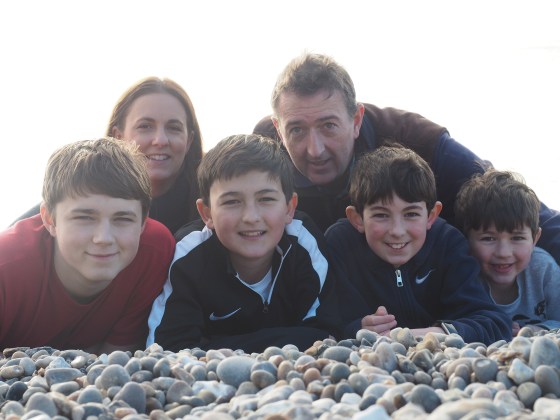
For the Davies-Carr family, who sought this opportunity themselves, it's a chance to further capitalize on their accidental swipe at fame, establish themselves as a valuable piece of digital history, and—hopefully—secure extra funds to go towards educating Charlie and Harry, now 15 and 17, and their two younger brothers.
Courtesy Howard Davies-CarrFor the Davies-Carr family, who sought this opportunity themselves, it’s a chance to further capitalize on their accidental swipe at fame, establish themselves as a valuable piece of digital history, and—hopefully—secure extra funds to go towards educating Charlie and Harry, now 15 and 17, and their two younger brothers.

Howard knows it might seem odd to sell the asset that has brought the family significant income over the years. But as the internet has shifted, he realized they needed to shift with it. “YouTube is always changing. The relationship we have with YouTube has changed,” he says. “You’re looking at this from a point of view that actually it should be there forever. Well, it might not be: they may change their terms and conditions in a year’s time, where actually uploaded, user-generated content is not important to them anymore.” Advertising revenue associated with the video has also dwindled. Making the video an NFT gives the family “a little bit more control.” Howard has long been an early adopter of new technology; he claims to have sent the first digital SMS over a satellite network in 1996. Plus, there’s a precedent for this kind of sale: Zoë Roth, the girl who appears in a frequently-memed image known on the internet as “Disaster Girl,” just auctioned the image as an NFT for nearly $500,000.

To former YouTube product manager Liu, who is now a co-founder of Origin Protocol, the auction platform that will host the sale for the Davies-Carrs, selling this video as an NFT just makes sense. Liu and Josh Fraser founded Origin Protocol in 2017 as a decentralized e-commerce platform directly connecting buyers and sellers, using blockchain as its currency. In 2021, they became a go-to site to host NFT sales: the musician 3LAU worked with Origin on the blockbuster sale of a series of original musical and art products that netted $11.7 million, setting sales records and making him one of the earliest and buzziest NFT creators. Already, however, some critics are suggesting that the NFT market is a bubble. Liu and Fraser see it as a similar scenario to the cryptocurrency bubble of 2017: when the hype dies down, the intrinsic value of this market will settle and, hopefully, remain intact.

Of course, “intrinsic” is a conceptually challenging adjective to apply to digital art or content like the “Charlie Bit My Finger” video. But the point is to assign clear value and ownership to items that before now have been floating in a formless ether. A painting with a verified signature by Picasso is worth more than a perfectly-replicated fake because the fine art community has agreed that origin matters. The NFT world believes that digital content deserves the same treatment and valuation, and by conducting auctions via blockchain, the authenticity and uniqueness of the NFT is guaranteed. Davies-Carr compares the eyebrow-raising at NFTs today to the quizzical early responses to British graffiti artist Banksy early in his career. “If I had said to you 10 years ago that someone’s going to go around doing graffiti on people’s buildings, and they’re going to cut those buildings out and put them in a museum? We would have said I was absolutely mad,” he says. “But things are changing all the time.” Plus, the buying and selling of virtual goods is not a new concept. In closed digital economies, like in video games such as World of Warcraft or Fortnite, real money is spent on virtual products. It’s big business. (It’s also the crux of a current court battle between Apple and Epic Games, creator of Fortnite, over Apple’s control over payments via the App Store.)

On May 22, there will be a certain satisfaction in seeing the Davies-Carr brothers capitalize on the global joy they spread as toddlers, and, for a moment, reclaim control of it. They won’t have control over where their video will end up, but they have one hope: “I’d like to think that maybe a purchaser is purchasing because they want to create a museum,” says Howard. Charlie and Harry plan to fly to meet the buyer and reenact their viral video in person one more time. After that? Back to school and, soon, off to college. Harry, the eldest, plans to study engineering. “But I’ll definitely be looking into, like, what’s happening in cryptocurrencies and stuff like that,” he adds. And he’ll keep an eye on NFTs, just in case one pops up that’s worth collecting.


Comments

Popular posts from this blog

New top story from Time: U.S. Donates 500,000 COVID-19 Vaccine Doses to Moldova

https://ift.tt/3xs4Uud BUCHAREST — Moldova is set to receive half a million doses of Johnson & Johnson vaccine from the United States to help the small nation combat the coronavirus pandemic. The first 150,000 doses of J&J are to arrive in Moldova — a country of 3.5 million, Europe’s poorest sandwiched between Romania and Ukraine — on July 12, the U.S. Embassy officials in Moldova said.. Moldovan President Maia Sandu thanked the U.S. for the vaccines and said that they will “help save lives, preserve the health of our citizens and reduce the force of the pandemic.” [time-brightcove not-tgx=”true”] “Now, we must mobilize ourselves and, in solidarity, get vaccinated,” Sandu, a former World Bank official, wrote online. The announcement came days ahead of an early) parliamentary election in Moldova that pits pro-Western reformists against a Russia-friendly bloc of Socialists and Communists, with recent polls giving a lead to the former. “This donation could not come...

24x7 RTGS for high-value transactions from December 14. Check details https://ift.tt/37TLyCy

The Real Time Gross Settlement System (RTGS) for high-value transactions will be available 24x7 on all days from December 14. This would make India one of the few countries to operate the system round-the-clock. "RTGS 24x7x365 will be launched with effect from 00:30 hours on December 14, 2020," the Reserve Bank of India (RBI) said in a statement. In October, the central bank had announced that RTGS will be available 24x7 on all days of the year. The RBI said India will become one of the few countries in the world to operate its RTGS system round-the-clock throughout the year.

New top story from Time: What to Know About the Real-Life Inspiration Behind Netflix’s Things Heard & Seen

https://ift.tt/3t2nRRk Within the first few minutes of the new Netflix film Things Heard & Seen , it’s clear something has gone very wrong. A man (James Norton) is seen pulling into the garage of an old home in the countryside. As he cuts the ignition on his car, a red droplet appears from above, falling onto his dashboard. He exits the car, looks up, sees liquid seeping through the floorboards and rushes inside the house, where a young girl is expectantly waiting for him. He scoops her up in his arms, and begins to run. What happened in that house? That question is at the center of Things Heard & Seen , which then rewinds to the previous spring and unpacks all that led up to this mysterious moment. The ‘80s-set thriller, which drops on the streaming platform on April 29, follows a young family—Catherine Clare ( Amanda Seyfried ), her husband George (Norton) and their daughter Franny (Ana Sophia Heger)—as they relocate from Manhattan to the Hudson Valley north of...

FOX NEWS: Boredom prompts half of Americans to start holiday shopping early, study claims It’s always such a relief to have Christmas shopping done before Halloween.

Boredom prompts half of Americans to start holiday shopping early, study claims It’s always such a relief to have Christmas shopping done before Halloween. via FOX NEWS https://ift.tt/2EATDBx

New top story from Time: How Liberal White America Turned Its Back on James Baldwin in the 1960s

https://ift.tt/2QBsNzv In discussions about race relations today, the works of James Baldwin continue to speak to the present, even decades after they were written. So it is worth remembering that, at the very height of his influence, Baldwin experienced the same frustration that some Black activists, particularly on campus, feel about white liberals today: their refusal to acknowledge their complicity in the regime of white supremacy. In Baldwin’s case, the liberal backlash was widespread, and effectively marginalized him for a time. The very first piece on the front page of the very first issue of The New York Review of Books , Feb. 1, 1963, was a review of Baldwin’s The Fire Next Time by F. W. Dupee of the Columbia English department. Dupee (a former Communist Party organizer) took exception to Baldwin’s apocalyptic tone. “Do I really want to be integrated into a burning house?” Baldwin had written. The answer, Dupee wrote, is that “[s]ince you have no other, yes; and t...

Sunday Streets Returns October 17, with Phoenix Day

Sunday Streets Returns October 17, with Phoenix Day By Pamela Johnson For 13 years, the SFMTA and Livable City have brought "Sunday Streets" to San Francisco neighborhoods. Sunday Streets encourages communities to transform miles of car-congested streets into car-free spaces for neighbors to gather, kids to play, and for organizations and businesses to connect. On October 17, 2021, after more than 18 months of Covid-related shutdowns, Sunday Streets Phoenix Day will again bring free recreational activities, resources, and fun to the streets for tens of thousands of San Franciscans to enjoy. While Sunday Streets was celebrated in one neighborhood at a time in the past, this year's Phoenix Day spans various districts in the City for a simultaneous celebration of community, health, and resilience. This year's theme is "One City. One day. Rising together.”  Highlights this year include historic Sunday Streets SF routes, a 20+ mile community bike ride, three neighb...

In-Person Bike and Roll Returns

In-Person Bike and Roll Returns By Christine Osorio The SFMTA is pleased to announce that for the first time since 2019, the San Francisco Safe Routes to School program’s annual Bike & Roll to School Week is back as an in-person event! Whether they’re on a bike, scooter, wheelchair, or skateboard, Bike & Roll to School Week (or BR2SW) celebrates all students using healthy, sustainable transportation to get to school. This year’s celebration is April 18-22, at schools citywide. Biking, rolling, and walking provides people of all ages with a sense of freedom and connection to their city. BR2SW encourages SF students to experience that through sustainable and joyful ways of getting around. With more people walking, biking, and rolling to school, pick-up and drop-off times are less congested with car traffic, and therefore safer and easier for everyone. San Francisco Safe Routes to School is a partnership of city agencies and nonprofits, led by the SFMTA, that helps make wal...

Govt offices in Bhubaneswar, Cuttack to function with 75 pc strength of employees in December https://ift.tt/2HQxXmI

All subordinate offices and departments in Bhubaneswar and Cuttack will function with 75 per cent strength of employees next month, the Odisha government said on Saturday. The directions cover entire staff including Group-A officers. The General Administration and Public Grievance Department on Saturday issued an official order in this regard and said that also said that all state government offices throughout the state will remain closed on Saturdays.

Breaking News LIVE: Top Headlines This Hour https://ift.tt/2GdhEPL

The total number of global coronavirus cases has surpassed 32 million, including more than 992,000 fatalities. More than 24,167,990 patients are reported to have recovered. Follow this breaking news blog for live updates on the coronavirus pandemic as it continues to pose a challenge for health workers and scientists who are in a race against time to produce a vaccine/medicine. 

New top story from Time: Sara Menker, CEO of Gro Intelligence, Believes Big Data Can Save Our Climate and Food Supply

https://ift.tt/3aAUWxz (Miss this week’s Leadership Brief? This interview below was delivered to the inbox of Leadership Brief subscribers on Sunday morning, Feb. 21; to receive weekly emails of conversations with the world’s top CEOs and business decisionmakers, click here .) Even by startup standards, the mission of Gro Intelligence is lofty. Sara Menker, the company’s founder and CEO, says its goal is to provide tools to help confront “two of the biggest challenges we face as humanity: food security and climate change.” Gro Intelligence uses AI and machine learning to provide thousands of clients, ranging from big food companies like Unilever and Yum! Brands to financial institutions including BNP Paribas and Wells Fargo, with a host of data and analysis on the global agricultural ecosystem. In all, Gro computers hoover up 650 trillion data points from more than 40,000 data sets—crop forecasts, satellite images, topography, reports on precipitation, soil moisture, evapotr...