Five years ago, Ben Platt received rapturous near-universal praise for his work as the protagonist of Dear Evan Hansen on Broadway. This month, he’s faced nearly the opposite reaction for playing the exact same role. The film adaptation of Dear Evan Hansen, which tells the story of a depressed teenager who gets caught in a web of lies, arrives in theaters Sept. 24—and critics have not been kind. Variety called it “deeply offensive.” “Undoubtedly the worst musical I have ever seen…Jail to everyone,” wrote one film critic on Twitter.
[time-brightcove not-tgx=”true”]
What went so wrong for Platt and the film’s creators? Did their creative decisions sink excellent source material, or was the well poisoned to begin with? And in an era in which we are suddenly deluged with movie musicals—with Cats, In the Heights, Everybody’s Talking About Jamie and West Side Story coming later this year—what makes a good adaptation, anyway? To discuss all of this and more, TIME convened two of its foremost theater nerds, who saw Dear Evan Hansen both on Broadway (with Platt) and on screen, Andrew R. Chow and Annabel Gutterman.
Read More: Cats Is Terrible, But It’s Also Kind of Great
Let’s jump right in. Is the film adaptation of Dear Evan Hansen really that bad?
Annabel Gutterman: As soon as I saw that they cut the musical’s first number, “Anybody Have a Map?” I knew we were in trouble. And I really wanted to like this movie. I loved the musical! Yes, Ben Platt does immediately look too old, but that’s nowhere near the top of my list of complaints here. While the original production was tense and anxiety-inducing, it never made me feel as unsettled as watching the movie. The arrival of the stage musical came at a time when it felt like just about every movie was becoming a musical—so maybe I was willing to give an original story more of a chance.
The central plot of Dear Evan Hansen—that Evan lied about being friends with a boy who killed himself, and then befriends that boy’s family (and manipulates the boy’s sister into falling in love with him!)—didn’t bother me as much as it did in the movie. That’s probably on me for suspending my disbelief in the theater. In the movie, this made it really hard for me to see Evan as a sympathetic character. Plus, they cut most of the time his mother was on screen. In the musical, her presence and absence are both so pronounced. She has two songs that were cut in the movie, the opening number and then the anger-fueled “Good for You.” Her character effectively served as this haunting reminder of how hard parents work to protect their children and for those efforts to basically not matter at all because of the Internet. The musical was a lot more about the relationship between a mother and son, an aspect of the story that felt lost in this adaptation.
Andrew R. Chow: Dear Evan Hansen was deeply uncomfortable and squirm-inducing; its characters did horrible things; Ben Platt looked bad. In other words: It was great!
The ways in which the DEHscourse has unfolded on Twitter over the last few months is driving me a little bit crazy. If you read many of those posts, you’d think the musical was a celebration of a scheming sociopath; that to like the musical means to support the protagonist’s actions. People are acting like the creepiness of the plot is an inherent flaw, as if that’s not the whole point of telling stories: to unsettle, to provoke, to interrogate human behavior.
We’re in an extremely strange cultural moment right now in which we’re both constantly glorifying villains (Cruella, Joker) and unequivocally condemning people for their actions. Dear Evan Hansen does neither: it in no way condones Evan’s lies, instead showing how a deeply insecure and traumatized teenager could do something so unspeakable. And I thought the movie did an excellent job in showing how someone so vulnerable and self-loathing could get caught up in a rapidly ballooning lie, thanks to the power of the Internet.
And the greatest irony of this whole situation is that the film critiques the exact circumstances that are spelling its doom. The play shows how social media is warping our social interactions, obscuring truths in favor of easy conclusions, and leading to vicious, undeserved pile-ons in which we judge people and things based on incomplete information. The hater train for Dear Evan Hansen left the station right when the trailer came out; since then, thousands of people have been actively rooting for it to fail, using it as an excuse to get off lacerating jokes and memes. This unrelenting flogging has accentuated all of the musical’s flaws while ignoring its strengths (a bonkers plot, beautiful music, an excellent supporting cast) and making it hard for anyone who does like it to come forward on social media without being roasted. Meanwhile, I look forward to people dismissing this article based on the headline alone!
AG: While I do agree with you that we don’t watch a movie to approve of its main character’s actions, I’m not quite sure that I ever really understood him. And more than that, I never really felt much for him. I knew I should be… sad? But I just felt empty. When it debuted on Broadway five years ago, Dear Evan Hansen seemed so different and ambitious because it was a musical about the dangers of the Internet. We hadn’t really seen that before!
But in 2021, it felt dated to me. Are kids really using YouTube that way now? I even thought that the way the high schoolers were quick to pull out their phones at different points to like, capture and share Evan embarrassing himself seemed very Thirteen Reasons Why. The whole thing screamed: adults writing about teens! That being said, I applaud the film for expanding on the Alana character a bit more. I enjoyed the song that Amandla Stenberg sang about how being a teen right now is super lonely (“The Anonymous Ones”). That felt like the most authentic part of the high school experience to me.
ARC: Amandla Stenberg was excellent; Kaitlyn Dever was excellent; I’m now a core member of the Nik Dodani fan club.
AG: Yes, Kaitlyn Dever was another standout. “Requiem” was by far my favorite song in the movie.
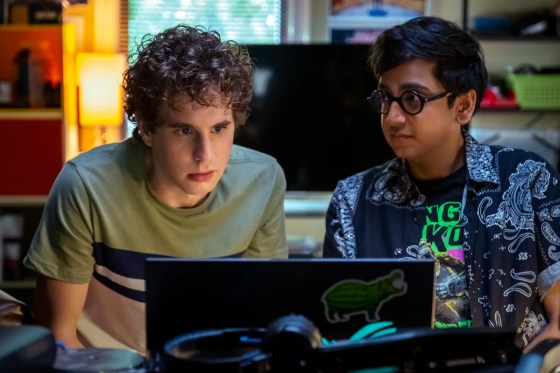
Was the film’s right or wrong to cast Ben Platt as Evan? How should the casting of musical adaptations be approached in general?
ARC: First off, Ben Platt’s casting here is a pretty open-and-shut case against nepotism. I would have hated to be the casting director watching Ben Platt pretend-hunch his shoulders while his father Marc Platt, the producer of the film, stood silently behind a glass panel.
But Ben Platt’s visible twenty-something-ness didn’t bother me as much as it is bothering other people, because Hollywood history is essentially a parade of twenty-somethings being cast a decade below their age. Alan Ruck in Ferris Bueller’s Day Off: 29. Rachel McAdams in Mean Girls: 25. Charisma Carpenter in Buffy the Vampire Slayer, season one: 27. Practically half the cast of Riverdale is 30, and Ansel Elgort, 27, plays the teenage Tony in the new West Side Story. But Ben Platt is where we’re drawing the line?
My issue with Platt’s casting has less to do with any forehead lines than the constant impulse for these adaptations to remain faithful to their show’s original casting. Platt is forever tied to the character, of course, but some of his replacements on Broadway, including Andrew Barth Feldman, have been just as formidable. In fact, the whole point of live theater is that roles are eminently fungible; that the roles live on far beyond their progenitors. This idea was proved fully when Lin-Manuel Miranda handed down the role of Usnavi in In the Heights to Anthony Ramos—who, Miranda himself admitted, did a far better job than he.
Read More: In the Heights Is a Love Letter to a New York City Neighborhood, Led by a Charismatic Star
AG: If only we could have seen Andrew Barth Feldman in this! I will say that Ben Platt has a very tough job. Evan is a character whose anxieties and tics were played up on stage in a way that really worked for me: his warped posture, the shakiness of his voice, his spit that flung in the air during “Words Fail.” When you are watching that happen live, it feels intimate and raw. On screen, his character’s emotional intensity was so amplified it actually distracted me and made me forget that Ben Platt was too old to play the character.
It bugs me that these huge Hollywood productions aren’t bigger vessels for the Broadway actors that starred in these roles. Like, really, we couldn’t have Rachel Bay Jones play Evan’s mom? Julianne Moore did a surprisingly affecting job, but Rachel Bay Jones also won a Tony for her performance in the stage version! We see this all the time: The Prom had an all-star cast and while it was fun to see Nicole Kidman talk-sing and throw her hands in the air, that could have been an opportunity for one of the actors of the beloved stage production to get more visibility.
When every movie adaptation of a Broadway show becomes a star-studded affair, the experience of watching it is so much more about the celebrity and less about the show itself. How are you ever really supposed to give into the story of Dear Evan Hansen when you’re wondering if Julianne Moore will actually be able to hit her high note? (Again, to be fair, I did enjoy Moore much more than I thought I would, but “So Big/So Small” fell a little flat for me).
ARC: I half-agree with you. Theater acting and film acting are like two different sports; the reason that theater actors are often stereotyped as being hammy is because they have to exaggerate their gestures to reach the back of the room. That impulse doesn’t always play well when a camera is staring you down from two feet away, capturing every lip quiver. Of course, that hasn’t stopped many theater actors from making the leap successfully—or from Broadway being overrun by movie stars who were bored of their Hollywood mansions and wanted to give New York City a try.
Really, what this discussion comes down to (and it always does) is money. Hollywood is fundamentally risk-averse; the moneymakers need to be able to put boldface names in front of their projects. Sadly, the commercial failure of In the Heights, which made a bet that people would come out for the little-known Ramos based on the film’s quality, probably means that the next batch of musicals will exclusively be cast with Kidman and the ever-eager James Corden.
Do we even want musical film adaptations? Who are they for?
AG: We do want musical film adaptations! I think. In theory, bringing Broadway to the masses should only be a good thing. But sometimes it just doesn’t fit. Dear Evan Hansen was a flop for me because it is too intimate of a musical to work as a big Hollywood movie. It is a story that doesn’t need all that extra stuff. If they had filmed a staged production, that would have resonated a lot more for me. I’m biased because one of my favorite Broadway musicals of all time, Come From Away, just did this and it totally worked. (Watch it on AppleTV! It will make you smile!) That show has a very bare bones set, no huge celebrity power, and a small group of actors playing a bunch of parts. It would make for a weird movie for the same reasons Dear Evan Hansen didn’t work—its success comes from the quieter moments of the story and the chemistry between cast members.
ARC: I agree that the smaller-scale stage-to-screen projects can often fall flat (both One Night In Miami and Ma Rainey’s Black Bottom felt very claustrophobic to me). The conversion of Dear Evan Hansen felt more natural to me because it’s inherently about screens—and I actually thought the choppy jump cuts of “Sincerely, Me” that accompanied Evan and Jared’s frantic email revisions worked much better in film than on stage.
What musical adaptations actually worked and why?
AG: Obviously, Mamma Mia is the first movie to come to my mind. And yes, it goes against everything I said in terms of celebrity because it has one of the most celebrity-packed casts of them all: Meryl Streep, Christine Baranski, Pierce Brosnan… But that movie also worked because it benefited from a bigger set (that they were able to film in Greece!), a larger cast and was anchored by so many huge dance numbers. There is never a point in that movie where I think, hmm, this scene feels like they are trying to fill up space with more people or things just because they can. Likewise, The Sound of Music is a perfect movie (fight me!) because the scope of the story (and the size of the setting) just makes sense on film. I really enjoyed Les Misérables (2012), too.
ARC: Honestly, the best musical adaptation I can think of is this year’s In the Heights. Director Jon M. Chu understood what made the original musical special (its cultural specificity and dynamic relationships) while also blowing it up with spellbinding movie magic. He and Lin-Manuel Miranda trusted a new generation of actors to carry the story forward, giving it relevance and buoyancy.
But Annabel, I’m so glad you mentioned Les Mis, one of the most notorious film adaptations in recent memory; Russell Crowe is still getting roasted for his quavering singing of “Stars.” But while many of those who saw it on Broadway turned up their noses, Les Mis was on at my house every holiday season and car ride. It brought so much joy to my little sister, who at the time was just entering the right age to start understanding concepts like morality, forgiveness, suicide and political dissent.
Seven years prior to Les Mis, Rent hit my preteen brain the same way: I didn’t know it was correct to critique Rosario Dawson as Mimi because I had never seen the original with Daphne Rubin-Vega, and because I was so swept up in the musical’s epic righteousness, its huge melodies, its devastating love stories. My and my sister’s experiences made me realize that musicals are inherently snark-proof and silly, and it doesn’t matter how much an Old like me or you hates any given adaptation. Everyone made fun of Cats and called it awful, but “rowdy” screenings of the film still sell out thanks to unabashed and unembarrassed superfans. So as long as one nerdy high schooler who never got a chance to go to Broadway finds some part of themselves that was missing thanks to the Dear Evan Hansen movie, then it was all worth it.
And meanwhile, for all of you who actually loved the stage musical and thought it deserved better than this particular version, fear not: Hollywood is so trigger-happy with reboots that some execs are probably currently plotting a separate version with Jacob Tremblay or a TikTok kid. I’ll be waving at you through the window in 2025.

Comments
Post a Comment