Construction Starts on the Battery/Sansome Quick-Build

Construction Starts on the Battery/Sansome Quick-Build
By Eillie Anzilotti

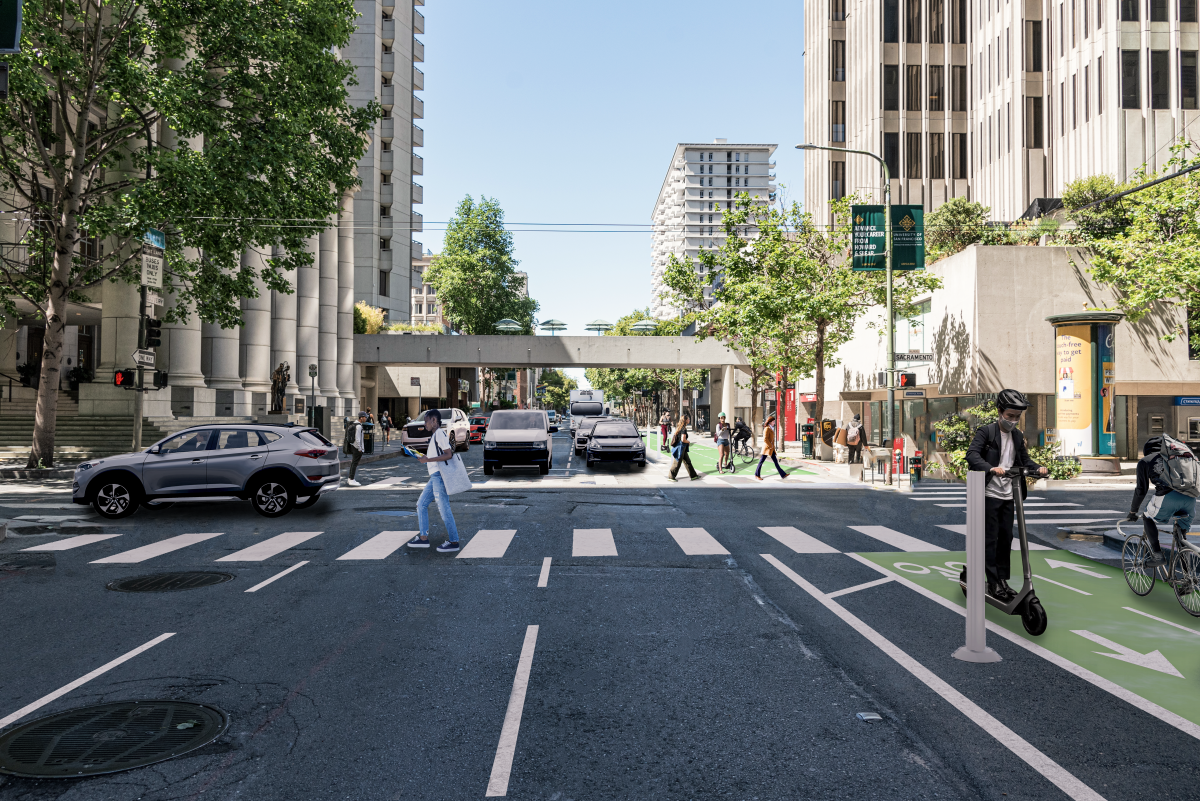
Rendered image of the completed Battery/Sansome Quick Build Project" 

Rendered image of the completed Battery/Sansome Quick Build Project

The first-ever protected bike lane in the Financial District is on its way in! 

This week, SFMTA crews are starting work on the Battery/Sansome Quick-Build project. Approved by the SFMTA Board of Directors in September, this project will bring a two-way protected bike lane to Battery Street. The project will also add pedestrian safety improvements on both Battery and Sansome Streets, and some loading changes on Battery.  

This project is a major step forward for cycling in the city. Apart from the Embarcadero, there is no other protected bike lane near the Financial District — even though two out of the 10 most active bike share stations in the city are in the downtown area. With so many people returning to downtown offices after working from home due to the pandemic, this new route will offer a safer option for those looking for a more active commute.  

Over the past year, SFMTA staff have worked with neighborhood stakeholders to come up with a design that meets current needs and supports downtown San Francisco’s future. During the same time, the Downtown SF Partnership — the neighborhood’s nonprofit that supports local businesses — commissioned a plan to imagine how the neighborhood could evolve out of the pandemic. Downtown was hit especially hard by COVID-19 and has been slow to recover. The Downtown SF Public Action Realm Plan makes a number of recommendations for activating the neighborhood, from more greenery to improved public spaces. The plan also calls for creating better bike connections and a safer, more welcoming pedestrian experience throughout the neighborhood. The Battery/Sansome Quick-Build project was named in the plan as an essential part of transforming Downtown SF into a more welcoming space for all. 

During our outreach, we heard a lot of enthusiasm for the idea of a two-way bike lane, which is now being built on Battery Street. But we also heard concerns that removing a vehicle travel lane could worsen congestion in the downtown area, especially during peak commute hours when people head toward the Bay Bridge. To address these concerns, the western side of the street will have commercial loading zones that local businesses will be able to use except for during peak hours, when the zones will need to be cleared. That way, the street will still have three functional vehicle travel lanes during rush hours. This solution was designed with the community to keep traffic flowing while creating a dedicated space for active travel.  

Construction will likely take up to three weeks, and we appreciate your patience as these important street improvements are completed. By early next year, the Battery/Sansome Quick-Build will be open for use to explore all that Downtown SF has to offer. As you’re riding through, make sure you stop to admire the new mural at the Battery Bridge by Peruvian-born, SF-based painter Talavera-Ballón — and share what you think of the new bikeway with our team. 

For more information and updates, please visit Battery/Sansome Quick-Build Project. 


Published November 29, 2022 at 03:18AM
https://ift.tt/epIvtUS

Comments

Popular posts from this blog

FOX NEWS: Father who was given months to live speaks out on thyroid cancer misconceptions A father who was told he had six months to a year to live when he got gravely ill from medullary thyroid cancer in 2019 has surpassed his doctor’s prediction, and he hopes others become “purveyors of positivity” after hearing his story.

Father who was given months to live speaks out on thyroid cancer misconceptions A father who was told he had six months to a year to live when he got gravely ill from medullary thyroid cancer in 2019 has surpassed his doctor’s prediction, and he hopes others become “purveyors of positivity” after hearing his story. via FOX NEWS https://ift.tt/2XlinXm

New top story from Time: How Spirited Away Changed Animation Forever

https://ift.tt/3xVoGP5 Twenty years ago, on July 20, 2001, a film that would become one of the most celebrated animated movies of all time hit theaters in Japan. Directed by Hayao Miyazaki and produced by Studio Ghibli, Sen to Chihiro no Kamikakushi, titled Spirited Away in English, would leave an indelible mark on animation in the 21st century. The movie arrived at a time when animation was widely perceived as a genre solely for children, and when cultural differences often became barriers to the global distribution of animated works. Spirited Away shattered preconceived notions about the art form and also proved that, as a film created in Japanese with elements of Japanese folklore central to its core, it could resonate deeply with audiences around the world. [time-brightcove not-tgx=”true”] The story follows an ordinary 10-year-old girl, Chihiro, as she arrives at a deserted theme park that turns out to be a realm of gods and spirits. After an overeating incident ...

A Green Light for Muni Customers

A Green Light for Muni Customers By Stephen Chun Have you ever been on a Muni vehicle and realized that if the light had only stayed green for just a few more seconds you wouldn’t have been trapped at a red light?  SFMTA’s Connected Corridor Pilot  approached this problem with a new state of the art solution.   Most signals in San Francisco do not have sensors to detect vehicles at an intersection. However, through a grant from the U.S. Department of Transportation, our project team was able to test an advanced technology for signal timing based on who is present at an intersection. In this way, transit platform and traffic signal sensor data can be used to activate signal timing adjustments, responding to traffic conditions in real time. These adjustments provide more opportunities for transit vehicles to make it through intersections on a green light.    The project team turned on the adaptive signal timing program during several days in Jul...

New top story from Time: Deaths and Blackouts Have Hit the U.S. Northwest Due to the Unprecedented Heat Wave

https://ift.tt/2UgzckI SPOKANE, Wash. — The unprecedented Northwest U.S. heat wave that slammed Seattle and Portland, Oregon, moved inland Tuesday — prompting a electrical utility in Spokane, Washington, to resume rolling blackouts amid heavy power demand. Officials said a dozen deaths in Washington and Oregon may be tied to the intense heat that began late last week. The dangerous weather that gave Seattle and Portland consecutive days of record high temperatures exceeding 100 degrees Fahrenheit (37.7 degrees Celcius) was expected to ease in those cities. But inland Spokane saw temperatures spike. The National Weather Service said the mercury reached 109 F (42.2 C) in Spokane— the highest temperature ever recorded there. [time-brightcove not-tgx=”true”] About 9,300 Avista Utilities customers in Spokane lost power on Monday and the company said more planned blackouts began on Tuesday afternoon in the city of about 220,000 people. “We try to limit outages to one hour per...

New top story from Time: The ‘Badass Chief of Staff’ of Turkey’s Opposition Faces Years in Jail After Challenging Erdogan’s Power. She’s Not Backing Down

https://ift.tt/2ZKUTZP Snow brings back memories for Dr. Canan Kaftancioglu. Of recess snowball fights in the Black Sea village where she grew up, of warming her hands at her elementary school’s stove before class — and of discovering a poem by Turkish writer Ataol Behramoglu, a favorite of a beloved uncle who would bring left-wing newspapers to her childhood home and discuss the articles inside. “It is about how the snow brings equality between people,” Kaftancioglu says of the poem. “In the snow, we build a new, more equal world.” The Turkish politician is speaking through an interpreter at her friends’ apartment in Istanbul’s Beyoglu district, seated in an armchair with a beige and brown-spotted dog curled up beside her. In a matter of days or weeks but likely not months, Kaftancioglu expects she will be taken to jail. For now, she’d rather focus on her work: the poverty rate is increasing, and people in her city are suffering. Kaftancioglu represents something unfamil...

New top story from Time: A Conversation with Filmmaker Adam Curtis on Power, Technology and How Ideas Get Into People’s Heads

https://ift.tt/2NQRzcY The British filmmaker Adam Curtis may work for the BBC, a bastion of the British elite, but over a decades-long career, he has cemented himself as a cult favorite. He is best known as the pioneer of a radical and unique style of filmmaking, combining reels of unseen archive footage, evocative music, and winding narratives to tell sweeping stories of 20th and 21st century history that challenge the conventional wisdom. “I’ve never thought of myself as a documentary maker,” he says. “I’m a journalist.” On Feb. 11, Curtis dropped his latest epic: Can’t Get You Out of My Head , an eight hour history of individualism, split up over six episodes. Subtitled “An emotional history of the modern world,” the goal of the series, Curtis says, was to unpack how we came to live in a society designed around the individual, but where people increasingly feel anxious and uncertain. It’s a big question, and Curtis attempts to answer it by taking us on a winding journ...

New top story from Time: How Are Activists Managing Dissension Within the ‘Defund the Police’ Movement?

https://ift.tt/3qRRGDU In June 2020, the Minneapolis city council announced plans to disband its police department following the killing of George Floyd . The council’s decision came after days of protesting and unrest in the city—and across the country —related to Floyd’s death and calls for larger-scale accountability from law enforcement. Central in many of these calls-for-action was a phrase soon to go global: “defund the police.” Eight months later, however, and the city’s police department has not been dissolved, though a lot has happened in the interim; Minneapolis’ struggle to implement meaningful reforms serves as a microcosm of how the “defund the police” movement has impacted the country. Council members who initially supported the idea have walked back their positions. In August the city charter delayed the council’s proposal to disband the police pending further review, only to reject the proposal entirely in November. ( Instead, there have been some rollback...

US NSA Jake Sullivan dials Indian counterpart Ajit Doval, reaffirms commitment for strong, enduring relations https://ift.tt/3agErFM

America’s new National Security Adviser Jake Sullivan in his first call with his Indian counterpart Ajit Doval on Wednesday reaffirmed the commitment of President Joe Biden to a strong and enduring bilateral strategic partnership based on shared commitment to democracy, the White House said.

New top story from Time: What Learned About Ourselves In the First Year of the Pandemic

https://ift.tt/3dTjNPp A version of this article appeared in this week’s It’s Not Just You newsletter . SUBSCRIBE HERE to have an It’s Not Just You essay delivered to your inbox every Sunday. March is the anteroom of months. It’s both the end of last year’s winter and the beginning of the new year’s spring. It’s half slush, half-quixotic hope. I had my first baby in March–a child that arrived nine days late, already a solid little being with startling almond eyes and the appetite of a toddler. I had no idea what I was doing; we two just hunkered down and tried to figure each other out. I still flounder at the start of every March, for different reasons every year, staggering out of February a soggy, angsty creature whose clothes don’t fit. But somehow, I slip-slide toward the end of the month, and things start to make sense. Maybe the vernal equinox is what helps get us back on track every spring. It’s that moment, usually, on the 20th or 21st of March, wh...

New top story from Time: The Split in How Americans Think About Our Collective Past Is Real—But There’s a Way Out of the ‘History Wars’

https://ift.tt/3gOBoti What are Americans supposed to know about the history of their country? Whose stories should be taught in classrooms, whose should be omitted and who decides? Such questions inform recent education bills like Louisiana’s HB564 and Iowa’s HF802 , which prohibit the teaching of “divisive concepts” and are just two of the latest entrants in an often-contentious dialogue reaching back to the founding of the Republic itself. But while there’s been a steady stream of opinions from politicians, pundits and professors about where to find “Historical Truth,” it’s always been hard to know how exactly the American public would answer these questions. Our recent national survey of people’s understandings and uses of the past, the full results of which will be published this summer, gives voice to the unheard masses. A collaboration between the American Historical Association and Fairleigh Dickinson University , and funded by the National Endowment for the Hu...