April 2022 Service Change Details

April 2022 Service Change Details
By Mariana Maguire

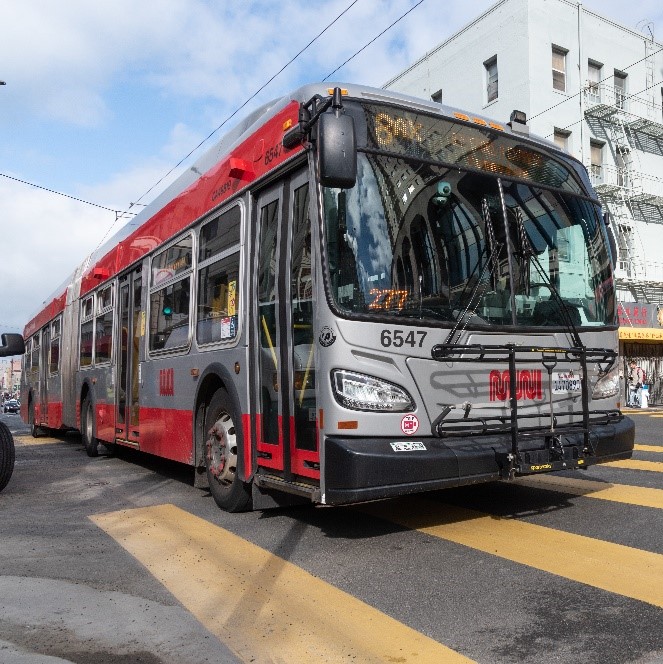
Photo showing an 8AX Bayshore Express articulated Muni bus on the road

The SFMTA is restoring the 8AX Bayshore Express and 8BX Bayshore Express buses on weekdays mornings and evenings, starting April 18, 2022, to provide quicker trips from Visitacion Valley to downtown and stronger connections between Visitacion Valley, Outer Mission, Ingleside, City College and Chinatown. Additional Muni service changes, beginning Saturday, April 16, 2022, include:

  • Extending the 56 Rutland to provide a more direct connection to Burton High School
  • Supplementing the 30 Stockton, with additional buses on a 30 Stockton “short” route to reduce crowding and wait times from about 7 a.m. to 4 p.m. on weekdays and about 8 a.m. to 5 p.m. on weekends
  • Changing the frequency of the 9R San Bruno Rapid from 10 to 12 minutes

These April service changes mark the second phase of implementation of the 2022 Muni Service Network plan.

In summer we expect to bring back additional routes that have been temporarily suspended since 2020 like the 2 Sutter (previously the 2 Clement), 10 Townsend and 21 Hayes, and modify existing routes like the 23 Monterey and 57 Parkmerced. See 2022 Muni Service Network for information. We will provide a more detailed description of the schedule as soon as it’s available.

Public feedback helped us prioritize bringing back routes and connections many communities rely on. Read more about what we heard from the public and how we incorporated feedback into the 2022 service plan.

What is keeping SFMTA from restoring more Muni service?

We want to restore Muni service as soon as possible. The key obstacle to restoring more Muni service is staff availability. Since fall 2021 the SFMTA has been hiring and training new cohorts of Muni operators to fill our staffing needs, and we continue to restore service at the pace of hiring.

We were short-staffed going into the pandemic and had to pause all hiring for 18 months. During that time some operators and key operations staff also left or retired, and more staff than usual have had to take time off to care for themselves or family members and loved ones impacted by the pandemic. We are also facing more retirements than previously anticipated.

Our hiring and training staff were also impacted and had to repeatedly postpone hiring and training activities. As a result of these and the related impacts of the Omicron surge, we’ve been bringing on new operators slower than we hoped, but we are still working to fill staffing gaps as quickly as possible.

We are committed to restoring pre-pandemic Muni service and are seeking new resources to help us restore, increase and improve service in 2023.

What do I need to know about riding Muni and COVID-19?

We’re excited to welcome you back to Muni, where the health of SFMTA employees and customers is a top priority. Since COVID-19 is primarily spread through the air, we understand the importance good air ventilation for protecting people’s health. The Muni fleet HVAC systems turn the air over once every minute. Fresh air is constantly being pulled in from the outside, and the air inside trains and buses is continuously filtered and recirculated. In addition, physical distancing is no longer required on Muni. On-vehicle capacity limits were officially lifted in June 2021.

When you ride Muni, there’s a high probability the person sitting next to you is vaccinated: 87% of San Francisco residents aged 5 and above are fully vaccinated. 68% of residents who are eligible for boosters (anyone age 12 and above) are boosted. Those are some of the highest vaccination rates in the U.S.

Even so, face masks are still required by federal law in Muni stations and vehicles, and Muni has a high mask compliance rate. Whenever the mask mandate on public transit is lifted, you can still wear a mask to protect yourself. One-way masking does work, especially when the mask is a surgical mask like the N95, KN95, KF94, FFP2, double mask or a cloth mask with a filter inside.

Looking Ahead

We expect to make our next round of service changes in the summer, when we continue implementing the approved 2022 Muni Service Network, restoring additional bus routes and increasing bus frequencies as we bring more operators onboard. Read more about the complete 2022 Muni Service Network plan.


Published April 12, 2022 at 12:06AM
https://ift.tt/wavpWkr

Comments

Popular posts from this blog

US Capitol breached by Trump supporters, woman killed; Joe Biden says 'dark moment' https://ift.tt/3oo7Za2

In an "unprecedented assault" on democracy in America, thousands of angry supporters of President Donald Trump stormed the US Capitol and clashed with police, resulting in casualty and multiple injuries and interrupting a constitutional process to affirm Joe Biden's victory in the presidential election.

New top story from Time: Beyond Tulsa: The Historic Legacies and Overlooked Stories of America’s ‘Black Wall Streets’

https://ift.tt/2R6bdDW Between May 31 and June 1, 1921, as many as 300 people were killed in one of the deadliest race massacres in U.S. history. Riled up by rumors of a Black man raping a young white woman, a white mob burned down the Tulsa, Okla., neighborhood of Greenwood—a.k.a. “Black Wall Street,” the affluent commercial and residential neighborhood founded in the city by Black Americans who went west after the Civil War. Now, 100 years after the 1921 Tulsa race massacre, awareness of this American tragedy has grown thanks to the work of activists and descendants of victims, local political support, and depictions in the HBO series Watchman and Lovecraft Country . But Tulsa’s was not the only Black Wall Street. The history of other such districts nationwide is still not widely known beyond their home cities, though they were many: Bronzeville in Chicago; Hayti in Durham , N.C.; Sweet Auburn in Atlanta; West Ninth Street in Little Rock, Ark.; and Farish Street in ...

'Situation not normal, don't lower guard': Delhi's 1st COVID patient cautions people https://ift.tt/35GmCxs

As many continue to take leeway during the festive season, Delhi's coronavirus patient has cautioned people to stay indoors as much as possible because "situation is not back to normal". Rohit Datta, who was diagnosed with the infection on March 1, appealed to the masses to "not lower guard" by getting into a casual festive mode. 

New top story from Time: The Security Perimeter Around the Capitol Starts to Recede — and Washington Feels a Little More Normal

https://ift.tt/3ssgaEo This article is part of the The DC Brief, TIME’s politics newsletter. Sign up here to get stories like this sent to your inbox every weekday. Washington isn’t a city particularly known for its rationality. We do overreaction better than most, and that talent is rivaled only by underreaction. Passions fuel far too much public policy, personalities dictate what is possible and personal relationships often triumph over pragmatism. It’s something I usually bemoan and curse under my breath — or, increasingly, in this newsletter. So you’ll forgive a moment of indulgent irrationality and some merriment. For, you see, the fencing around the U.S. Capitol has come down. Well, not all of it. And the barriers that remain don’t have an expiration date and may never get one. But at least some of the garish barricades that went up in response to the deadly failed insurrection on Capitol Hill on Jan. 6 have been dismantled. The razor-wire on its top is gone, too...

New top story from Time: Our Eyes on the Virus: Why We Still Need Widespread Rapid Testing Even With Vaccines

https://ift.tt/3i5MoTN The vaccines are here. Why do we still need testing? Testing is our eye on the virus. Without testing, we can’t see where it is or where it is going. As fall and winter set in, outbreaks will again occur, sparked by the unvaccinated. And most people become infectious before they know they are infected. Frequent and accessible rapid testing is a tool that if deployed last summer and fall would have saved 100,000 lives. The U.S. missed the opportunity to use frequent rapid testing to stop individuals from unintentionally spreading the lethal SARS-CoV-2 virus to our most vulnerable and avert the horrific winter surge. By rapid tests, I mean the tests that an individual can conduct without a laboratory (ideally in the privacy of their own home) with results given in real-time. There are two types: rapid antigen tests, which look for the virus’s proteins and detect infectious levels of virus. The other lets you know you’ve been infected: rapid molecular...

FOX NEWS: Toddler admitted into American Mensa has an IQ of 146, makes history as youngest member A 2-year-old girl has just made history as the youngest member of American Mensa.

Toddler admitted into American Mensa has an IQ of 146, makes history as youngest member A 2-year-old girl has just made history as the youngest member of American Mensa. via FOX NEWS https://ift.tt/3yHFGc7

New top story from Time: Germany Has Officially Recognized Colonial-Era Atrocities in Namibia. But For Some, Reconciliation Is a Long Way Off

https://ift.tt/3fVRkaO The German government formally recognized colonial-era atrocities against the Herero and Nama people in modern-day Namibia for the first time, referring to the early 20th century massacres as “genocide” on Friday and pledging to pay a “ gesture to recognize the immense suffering inflicted.” “In light of the historical and moral responsibility of Germany, we will ask Namibia and the descendants of the victims for forgiveness,” said German Foreign Minister Heiko Maas in a statement , adding that the German government will fund projects related to “reconstruction and the development” of Namibia amounting to €1.1 billion ($1.3 billion). The sum will be paid out over 30 years and must primarily benefit the descendants of the Herero and Nama, Agence France-Presse reported . [time-brightcove not-tgx=”true”] Although it’s a significant step for a once colonial power to agree such a deal with a former colony, there’s skepticism among some experts and ob...

New top story from Time: The Most Powerful Court in the U.S. is About to Decide the Fate of the Most Vulnerable Children

https://ift.tt/34relNF When child custody cases come before family courts, judges endeavor to base their rulings on the best interests of the child. Overall, the court is less interested in which parent might have the most right to the children than in how best to help the children thrive. The Supreme Court might now be walking a very similar line. It is on the verge of deciding a landmark case that could have a profound impact on the more than 400,000 vulnerable children who find themselves in the U.S. foster care system. Its ruling could also have major implications for LGBTQ rights, religious liberty and nondiscrimination laws across America. [time-brightcove not-tgx=”true”] The case, Fulton v. City of Philadelphia , was sparked when the city said it would no longer contract with a faith-based agency, Catholic Social Services (CSS), to provide foster services after a 2018 Philadelphia Inquirer article revealed that it would not certify same-sex couples to be foster pare...

New top story from Time: 2021 Could Be the Biggest Wedding Year Ever. But Are Guests Ready to Gather?

https://ift.tt/3wC3WKU I was supposed to get married in September. Well, technically, as my husband would be quick to correct me, I did get legally married in September 2020 in the courtyard of our New York City apartment building in front of our parents, a handful of friends who lived nearby and a naked guy standing in the window of the building next door, who, I am told, cheered when we recessed. The 13 people in attendance wore masks I’d ordered with our wedding date printed on them, sat in distanced lawn chairs and sipped gazpacho I’d blended and individually bottled that morning in a frenzy of health-safety panic. [time-brightcove not-tgx=”true”] This was not the wedding of 220 people that we had originally planned. A few months into the pandemic, we made the call to delay our big celebration until 2021. We were hardly alone. In a typical year, Americans throw 2 million weddings, according to wedding website the Knot. Last year, about 1 million couples in the U.S. post...

New top story from Time: Constance Wu and Jenny Han on the Power of Inclusive Storytelling

https://ift.tt/3wFvLCm In conversation with senior editor Lucy Feldman as part of TIME’s “Uplifting AAPI Voices” summit , actor Constance Wu and To All the Boys I’ve Loved Before author Jenny Han discussed their groundbreaking work both in front of and behind the camera, the need for nuanced Asian American and Pacific Islander (AAPI) representation and their love for a good rom-com. TIME: When the film adaptations of Crazy Rich Asians and To All the Boys I’ve Loved Before first came out, there was a whole generation of Asian Americans who had never seen ourselves reflected like that. What did those films mean to you? And how did they change things? [time-brightcove not-tgx=”true”] Wu: I was in a unique position, having that happen to me with two big-profile projects: first there was Fresh Off the Boat, which was seeing yourself represented on network American TV. That was something that really hadn’t happened in a long time. Crazy Rich Asians was on a bigger sc...