
New top story from Time: These Are the Best and Worst Moments From the 2020 MTV VMAs

https://ift.tt/3ju6PXU

It was just a year ago that the Jonas Brothers sauntered down Asbury Park to a roaring, penned-in crowd for the MTV Video Music Awards. Such a scene would be unthinkable in today’s socially distanced climate—and on Sunday, MTV took on the tall task of producing one of first major U.S. live awards shows of the COVID-19 era.

In front of a crowd of no one in New York City, Keke Palmer hosted the proceedings; Lady Gaga, Ariana Grande, BTS, the Weeknd, DaBaby, Miley Cyrus and others performed in sequences that were shot across the city or in front of greenscreens. The socially distanced setup actually improved the show in some respects: there were no agonizingly slow walks to the stage or stifling bleeps of live audio, and the runtime was a relatively brisk two and a quarter hours.

But the show also missed the scale and spontaneity that has previously made the VMAs so unpredictable and compelling. Here are the show’s most memorable moments, for better or worse.

Best Overall: Lady Gaga

Keke Palmer may have been the hosted the show, but Lady Gaga was the big star. She waltzed to the stage repeatedly to collect four on-camera awards—including Artist of the Year—and was given free rein to play a winding medley from her new album, Chromatica. In these bite-sized chunks of time onstage, she showed flashes of why she’s been one of the most reliable pop stars over the last decade, with brawny vocal runs, idiosyncratic dance routines, splashes of bluesy piano and compassionate acceptance speeches.

But her masks were perhaps the most memorable aspect of her night. It’s not surprising that Gaga, who has been visually radical since she arrived in the pop world a decade ago, would make the best out of a dicey situation, even one that requires covering her famous nose. But she raised the bar for PPE fashion going forward, coming out first with an inset-like gas-mask getup; then a tentacles to become a cousin of Pirates of the Caribbean’s Davy Jones; then a reflective silver one recalling Watchmen’s Looking Glass, and finally an imposing head-to-toe ensemble a la Maleficent.
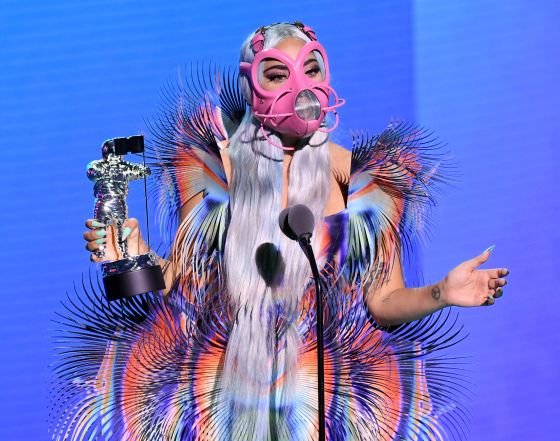
2020 MTV Video Music Awards - Show
Getty Images for MTVLady Gaga accepts the Best Collaboration award for “Rain on Me” with Ariana Grande onstage during the 2020 MTV Video Music Awards.

Best: Dystopian Sets

Nothing about 2020 is normal, and thankfully, the VMAs and its artists didn’t try to carry on as usual, but instead embraced dystopian aesthetics throughout, leaning into what Lady Gaga termed onstage as “the wrath of pop culture” and “the rage of art.” Palmer stood on a huge digital stage surrounded by more screens on which tiny audience members flicked in and out; in the virtual rafters, shadowy Sims-like avatars roared their approval.

The Weeknd showed up disoriented, bandaged and bloodied (as he has during press appearances for most of this year). DaBaby performed on top of a cop car and in front of a greenscreen of a smoldering cityscape. Doja Cat pranced through a reddish desolate landscape that resembled either Mars or the bottom of the sea. And constant references to death—from Chadwick Boseman to Jacob Blake to those killed by the coronavirus—lent a somberness to the show that reflected the year at large.

Worst: Lack of Hip-Hop

On the other hand, the VMAs seemed to exist in an alternate reality in which hip-hop isn’t the driving force of the modern music industry. Only one true rap song won an on-camera prize, and it was in the hip-hop category, which was presented, for some dumbfounding reason, by Blink-182 drummer Travis Barker. The VMAs are supposed to be the more forward-thinking younger brother of the Grammys, but many of the year’s biggest stars—including Lil Uzi Vert, Lil Baby, YoungBoy Never Broke Again and Roddy Ricch—were nowhere to be found.

Instead, the telecast was dominated by songs indebted to 80s pop, from the Weeknd’s go-go synth pop anthem “Blinding Lights” to Miley Cyrus’s Stevie Nicks-inspired “Midnight Sky.” The VMAs landed big stars, but mostly failed to capture what the dominant stream of music actually sounds like today. J-Hope of BTS put it best, during the K-pop group’s breezy performance of “Dynamite”: “Disco overload / I’m good with that, I’m good to go.”

Best: Boy Bands

Still, it was hard not to be charmed by the two boy bands that performed on Sunday: BTS, from South Korea, and CNCO, from Latin America. The former performed “Dynamite,” their first fully English language song, with crisp choreography and snazzy color-coordinated suits. The latter embraced the strange setup of the drive-in concert at Skyline Drive-In in Greenpoint by wandering into the metallic audience and jumping on top of cars. The performance looked retro and futuristic at the same time.

CNCO
Kevin Mazur/MTV VMAs 2020/Getty Images for MTVCNCO performs at the 2020 MTV Video Music Awards at the Skyline Drive-In in New York City.

Best: Chloe x Halle

One of the night’s most electric performances was relegated to the pre-show. The R&B duo Chloe x Halle have broken out this year thanks to both their immaculate album Ungodly Hour and their poised, shrewdly-shot home performances. Their pre-taped VMAs performance was no exception: they sang and danced to a reworked version of the album’s jazzy title-track inside of a conical strobe. With any luck, they’ll be on the mainstage next year.

Worst: Keke Palmer’s Impressions

Overall, Palmer made the out of a tough gig, bringing her trademark exuberance and mischievousness to inject energy straight to the camera from various spots around the city. But Palmer thrives most in informal settings and when bouncing off other personalities—as evidenced by her many viral interviews or the “sorry to this man” meme—and in comparison, her crowdless exhortations lacked verve. A running bit in which she tried on some impressions—including a skeevy male street performer, a ditz and an haute socialite—likewise fell flat. On the other hand, she was a whole lot better than last year’s host, Sebastian Maniscalco.

Comments

Popular posts from this blog

New top story from Time: How 3 Key In the Heights Scenes Were Reimagined From Stage to Screen

https://ift.tt/3iIBhAh When director Jon M. Chu first saw the musical In the Heights on Broadway in 2008, his imagination whirred to life with possibilities. “Imagine if this was in a tunnel and the tunnel lights up?” he remembers thinking while sitting in the theater. “Imagine if you could look through a window of somebody dreaming, and the community could be reflected in the reflection?” More than a decade later, Chu is bringing these reveries to life as the director of the musical’s film adaptation, which arrived in theaters and on HBO Max on June 11. While other recent film-to-stage adaptations — like Ma Rainey’s Black Bottom and One Night in Miami — have leaned into the intimate, contained aesthetic of theatrical performances, Chu’s In the Heights has the ambition and scale of the most epic blockbuster films, complete with hundreds of extras and dancers, vibrant animated graphics, gravity-defying Fred Astaire-inspired dance numbers, and plenty of slick camerawork ...

New top story from Time: Germany Has Officially Recognized Colonial-Era Atrocities in Namibia. But For Some, Reconciliation Is a Long Way Off

https://ift.tt/3fVRkaO The German government formally recognized colonial-era atrocities against the Herero and Nama people in modern-day Namibia for the first time, referring to the early 20th century massacres as “genocide” on Friday and pledging to pay a “ gesture to recognize the immense suffering inflicted.” “In light of the historical and moral responsibility of Germany, we will ask Namibia and the descendants of the victims for forgiveness,” said German Foreign Minister Heiko Maas in a statement , adding that the German government will fund projects related to “reconstruction and the development” of Namibia amounting to €1.1 billion ($1.3 billion). The sum will be paid out over 30 years and must primarily benefit the descendants of the Herero and Nama, Agence France-Presse reported . [time-brightcove not-tgx=”true”] Although it’s a significant step for a once colonial power to agree such a deal with a former colony, there’s skepticism among some experts and ob...

US Capitol breached by Trump supporters, woman killed; Joe Biden says 'dark moment' https://ift.tt/3oo7Za2

In an "unprecedented assault" on democracy in America, thousands of angry supporters of President Donald Trump stormed the US Capitol and clashed with police, resulting in casualty and multiple injuries and interrupting a constitutional process to affirm Joe Biden's victory in the presidential election.

'Situation not normal, don't lower guard': Delhi's 1st COVID patient cautions people https://ift.tt/35GmCxs

As many continue to take leeway during the festive season, Delhi's coronavirus patient has cautioned people to stay indoors as much as possible because "situation is not back to normal". Rohit Datta, who was diagnosed with the infection on March 1, appealed to the masses to "not lower guard" by getting into a casual festive mode. 

New top story from Time: The Security Perimeter Around the Capitol Starts to Recede — and Washington Feels a Little More Normal

https://ift.tt/3ssgaEo This article is part of the The DC Brief, TIME’s politics newsletter. Sign up here to get stories like this sent to your inbox every weekday. Washington isn’t a city particularly known for its rationality. We do overreaction better than most, and that talent is rivaled only by underreaction. Passions fuel far too much public policy, personalities dictate what is possible and personal relationships often triumph over pragmatism. It’s something I usually bemoan and curse under my breath — or, increasingly, in this newsletter. So you’ll forgive a moment of indulgent irrationality and some merriment. For, you see, the fencing around the U.S. Capitol has come down. Well, not all of it. And the barriers that remain don’t have an expiration date and may never get one. But at least some of the garish barricades that went up in response to the deadly failed insurrection on Capitol Hill on Jan. 6 have been dismantled. The razor-wire on its top is gone, too...

New top story from Time: Our Eyes on the Virus: Why We Still Need Widespread Rapid Testing Even With Vaccines

https://ift.tt/3i5MoTN The vaccines are here. Why do we still need testing? Testing is our eye on the virus. Without testing, we can’t see where it is or where it is going. As fall and winter set in, outbreaks will again occur, sparked by the unvaccinated. And most people become infectious before they know they are infected. Frequent and accessible rapid testing is a tool that if deployed last summer and fall would have saved 100,000 lives. The U.S. missed the opportunity to use frequent rapid testing to stop individuals from unintentionally spreading the lethal SARS-CoV-2 virus to our most vulnerable and avert the horrific winter surge. By rapid tests, I mean the tests that an individual can conduct without a laboratory (ideally in the privacy of their own home) with results given in real-time. There are two types: rapid antigen tests, which look for the virus’s proteins and detect infectious levels of virus. The other lets you know you’ve been infected: rapid molecular...

FOX NEWS: Toddler admitted into American Mensa has an IQ of 146, makes history as youngest member A 2-year-old girl has just made history as the youngest member of American Mensa.

Toddler admitted into American Mensa has an IQ of 146, makes history as youngest member A 2-year-old girl has just made history as the youngest member of American Mensa. via FOX NEWS https://ift.tt/3yHFGc7

New top story from Time: The Most Powerful Court in the U.S. is About to Decide the Fate of the Most Vulnerable Children

https://ift.tt/34relNF When child custody cases come before family courts, judges endeavor to base their rulings on the best interests of the child. Overall, the court is less interested in which parent might have the most right to the children than in how best to help the children thrive. The Supreme Court might now be walking a very similar line. It is on the verge of deciding a landmark case that could have a profound impact on the more than 400,000 vulnerable children who find themselves in the U.S. foster care system. Its ruling could also have major implications for LGBTQ rights, religious liberty and nondiscrimination laws across America. [time-brightcove not-tgx=”true”] The case, Fulton v. City of Philadelphia , was sparked when the city said it would no longer contract with a faith-based agency, Catholic Social Services (CSS), to provide foster services after a 2018 Philadelphia Inquirer article revealed that it would not certify same-sex couples to be foster pare...

New top story from Time: 2021 Could Be the Biggest Wedding Year Ever. But Are Guests Ready to Gather?

https://ift.tt/3wC3WKU I was supposed to get married in September. Well, technically, as my husband would be quick to correct me, I did get legally married in September 2020 in the courtyard of our New York City apartment building in front of our parents, a handful of friends who lived nearby and a naked guy standing in the window of the building next door, who, I am told, cheered when we recessed. The 13 people in attendance wore masks I’d ordered with our wedding date printed on them, sat in distanced lawn chairs and sipped gazpacho I’d blended and individually bottled that morning in a frenzy of health-safety panic. [time-brightcove not-tgx=”true”] This was not the wedding of 220 people that we had originally planned. A few months into the pandemic, we made the call to delay our big celebration until 2021. We were hardly alone. In a typical year, Americans throw 2 million weddings, according to wedding website the Knot. Last year, about 1 million couples in the U.S. post...

New top story from Time: Constance Wu and Jenny Han on the Power of Inclusive Storytelling

https://ift.tt/3wFvLCm In conversation with senior editor Lucy Feldman as part of TIME’s “Uplifting AAPI Voices” summit , actor Constance Wu and To All the Boys I’ve Loved Before author Jenny Han discussed their groundbreaking work both in front of and behind the camera, the need for nuanced Asian American and Pacific Islander (AAPI) representation and their love for a good rom-com. TIME: When the film adaptations of Crazy Rich Asians and To All the Boys I’ve Loved Before first came out, there was a whole generation of Asian Americans who had never seen ourselves reflected like that. What did those films mean to you? And how did they change things? [time-brightcove not-tgx=”true”] Wu: I was in a unique position, having that happen to me with two big-profile projects: first there was Fresh Off the Boat, which was seeing yourself represented on network American TV. That was something that really hadn’t happened in a long time. Crazy Rich Asians was on a bigger sc...