Muni Improvements Draw Increased Ridership

Muni Improvements Draw Increased Ridership
By Kate McCarthy

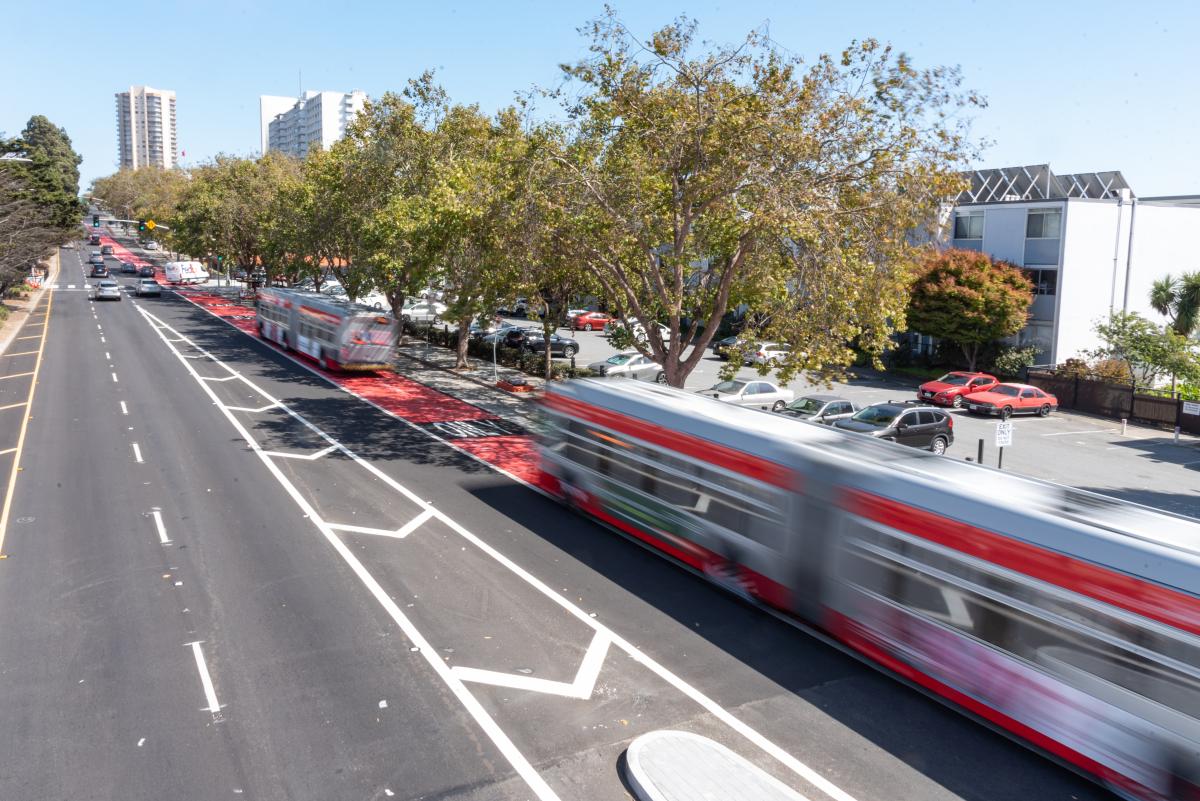
Buses driving towards downtown on Geary Boulevard.

38 Geary buses zip downtown on new transit lanes that improve travel times for Muni riders.

As Earth Day approaches and we think about how to encourage more people to take non-car trips, recent Muni improvement projects are drawing increased ridership across the city. While Muni ridership downtown has not yet rebounded to pre-pandemic levels, ridership has gone up on Muni lines where we have improved speed and frequency of Muni service. 

Muni is a lifeline for many of our riders: 70% of Muni riders have an annual income of less than $50,000. As we restored and added Muni service after the start of the pandemic, we invested in the routes that serve people who rely on transit and need it most. For example, after we installed transit lanes, increased frequency and re-routed the 22 Fillmore to bring people to their jobs and medical appointments in Mission Bay, ridership increased to 107% of pre-pandemic levels on weekdays and 118% on weekends. 

Since the start of the pandemic, we’ve implemented more than 21 miles of new transit priority lanes, growing our transit lane network (https://ift.tt/dyMYueI) to over 70 miles. These transit lanes are improving travel times for Muni riders across the city. After transit lanes were installed on Mission Street in downtown, travel times on the 14 Mission and 14R Mission Rapid are now 31% quicker. 

Ridership numbers on the 49 Van Ness-Mission also blossomed to 109% of pre-pandemic ridership on weekdays and 114% on weekends after construction on the Van Ness BRT corridor was completed last April. With physically-separated transit lanes and transit signal priority that gives the green light to Muni and Golden Gate Transit buses, riders there are seeing travel times reduced by 35%. 

A similar story has emerged on San Francisco’s busiest transit boulevard — Geary. Like other lines that serve downtown, the 38 Geary hasn’t fully recovered to pre-pandemic ridership levels. But the route did nab a spot in the top 10 highest recovered routes in the Muni system. The 38 Geary’s 36,000 daily riders have recently seen travel time savings of up to 18% since we installed three miles of new transit lanes, bus stop changes and other improvements as part of the Geary Rapid Project. We plan similar improvements on the western end of the corridor as part of the Geary Boulevard Improvement Project.     

Muni riders have noticed that improvements to our busiest Muni lines are making service faster and more reliable than it has been in decades. Two-thirds (66%) of Muni riders who took our Annual Muni Rider Survey last fall rated Muni service as “good” or “excellent” — a 9% increase from 2021 and the strongest increase since 2018. 

These improvements can’t come soon enough. Most of San Francisco’s greenhouse gas emissions come from cars and trucks. As the urgency to address climate change mounts, so does the need to get the most out of our Muni system. To inspire riders to come back to Muni, we’re working hard to bring back the Muni system our city deserves: One that is thriving with the better frequency, improved reliability and better connections that these projects are delivering. 


Published April 21, 2023 at 02:24AM
https://ift.tt/rKHxJ8v

Comments

Popular posts from this blog

New top story from Time: What We Have In Common With Humans Of 23,000 Years Ago

https://ift.tt/3uFiyti A version of this article also appeared in the It’s Not Just You newsletter. Sign up to get a new edition from Susanna every Saturday. Recently, researchers reported that they’d found the oldest human footprints in North America. These fossilized tracks were made more than 21,000 years ago in what is now the White Sands National Park in New Mexico. It’s hard to comprehend that span of years and how many generations of humanity have come and gone since then. These were the slighted impressions on the earth—trace markings made by bare human feet pressing into the pliant mud of ancient lake. Yet they survived the Ice Age and everything since to represent people who left hardly any indications that they existed. [time-brightcove not-tgx=”true”] I think about the mountain of documentation we each have of our lives in comparison to those ancient footprints. We’re sure we’ll leave acres of personal history when we go—thousands of photos on dozens of ...

New top story from Time: The U.S. and the Taliban Discuss Security and Terrorism Concerns in Doha

https://ift.tt/3oPVZ4j A U.S. delegation met with senior Taliban representatives in Doha, Qatar, over the weekend to discuss issues including security, terrorism and human rights, their first direct talks since the chaotic U.S. withdrawal from Afghanistan in late August. The “candid and professional” discussions covered the need for safe passage of U.S. citizens, other foreign nationals and Afghan partners, State Department spokesman Ned Price said in a statement Sunday. The U.S. also called for “the meaningful participation of women and girls in all aspects of Afghan society.” “The two sides also discussed the United States’ provision of robust humanitarian assistance, directly to the Afghan people,” Price said, adding that “the Taliban will be judged on its actions, not only its words.” [time-brightcove not-tgx=”true”] The meetings were among the first formal engagements between the State Department and the Taliban since the U.S. evacuated its diplomats and troops from K...

Bonds, Strikes and Natural Disasters: The Origins of Muni

Bonds, Strikes and Natural Disasters: The Origins of Muni By Jeremy Menzies The first San Francisco Municipal Railway streetcars rolled into service 109 years ago on December 28, 1912. Muni was not the first transit provider in the city, nor the first publicly run railway in the country. However, it was the first to be established in a major US city, giving it widespread recognition. Muni’s immediate success  set an example that many cities across the country would come to follow.  Reflecting on this recently passed anniversary, we took a look at some of the key events that led to the creation of Muni. What we found was a unique political, economic and social climate in San Francisco around the turn of the 20th century, all leading to the establishment of “the people’s railway”..  ...

New top story from Time: More Than 130 Countries Reach Deal on Corporate Minimum Tax

https://ift.tt/3amKfxS (FRANKFURT, Germany) — More than 130 countries have agreed on sweeping changes to how big global companies are taxed, including a 15% minimum corporate rate designed to deter multinationals from stashing profits in low-tax countries. The deal announced Friday is an attempt to address the ways globalization and digitalization have changed the world economy. It would allow countries to tax some of the earnings of companies located elsewhere that make money through online retailing, web advertising and other activities. U.S. President Joe Biden has been one of the driving forces behind the agreement as governments around the world seek to boost revenue following the COVID-19 pandemic. [time-brightcove not-tgx=”true”] The agreement among 136 countries representing 90% of the global economy was announced by the Paris-based Organization for Cooperation and Economic Development, which hosted the talks that led to it. The OECD said that the minimum tax would...

Farm Bills row: Punjab, Haryana farmers extend 'rail roko' stir till Sept 19. Here's what happened so far https://ift.tt/2Ey5QXF

Farmers in Punjab and Haryana on Friday took to the streets in protest against the contentious farm Bills passed by Parliament recently. In Punjab, where the "bandh" was near-total, the "rail roko" agitation was extended by three days till September 29. Earlier, a farmers' body had announced to block trains from September 24 to 26. Shops, commercial establishments, vegetables and grains markets remained shut at almost all places with farmers' bodies describing it as "unprecedented" support for their cause.

New top story from Time: Employers Are Starting to Adopt ‘Menstrual Leave’ Policies. Could It Backfire?

https://ift.tt/3DnOzsX As a municipal employee of five years in the Catalan city of Girona, Spain Miriam Requena has an array of benefits: sick leave, personal days and paid vacation time. When menstrual leave was added to the list, she was initially surprised. “I had never realized that we needed this kind of flexibility,” 31-year old Requena told TIME. But she quickly saw its value. “It shatters all taboos to be able to say ‘listen, I’m menstruating, sometimes that provokes certain pains that impede me from going to work or being 100% productive.’” [time-brightcove not-tgx=”true”] The city of Girona recently became the first city in Spain to consider a menstrual leave policy for its more than 1,300 employees in April. A clutch of municipalities soon followed suit, from the Catalan towns of Ripoll and Les Borges Blanques to the eastern city of Castellón de la Plana , casting a handful of public administrations in Spain as standard-bearers and pioneers in Western Eur...

New top story from Time: Mongolian People’s Party Retains Strong Majority in Parliamentary Election

https://ift.tt/31eCabd (ULAANBAATAR, Mongolia) — Preliminary election results show the Mongolian People’s Party retaining a strong parliamentary majority, winning 62 of 76 seats, as the landlocked U.S. ally sandwiched between Russia and China seeks to retain its democratic traditions amid economic woes. The main opposition Democratic Party won 11 seats, while three others were taken by independents and coalitions, the General Election Commission reported on Thursday. Wednesday’s polls were held amid considerable success in the country’s fight against the coronavirus, with just 215 cases of COVID-19 recorded. All of them were imported and no one has died. People lining up to vote in the capital, Ulaanbaatar, were required to maintain a distance of 2 meters (6.5 feet) between them. Once inside the polling place, election workers checked their temperatures and distributed hand sanitizer. Economic malaise, corruption and weak public services dominated concerns among the countr...

FOX NEWS: With attendance declining, the church needs 'authenticity' 'Ainsley's Bible Study' discusses the importance of authenticity to the church on Fox Nation.

With attendance declining, the church needs 'authenticity' 'Ainsley's Bible Study' discusses the importance of authenticity to the church on Fox Nation. via FOX NEWS https://ift.tt/346U2Vo

New top story from Time: How Liberal White America Turned Its Back on James Baldwin in the 1960s

https://ift.tt/2QBsNzv In discussions about race relations today, the works of James Baldwin continue to speak to the present, even decades after they were written. So it is worth remembering that, at the very height of his influence, Baldwin experienced the same frustration that some Black activists, particularly on campus, feel about white liberals today: their refusal to acknowledge their complicity in the regime of white supremacy. In Baldwin’s case, the liberal backlash was widespread, and effectively marginalized him for a time. The very first piece on the front page of the very first issue of The New York Review of Books , Feb. 1, 1963, was a review of Baldwin’s The Fire Next Time by F. W. Dupee of the Columbia English department. Dupee (a former Communist Party organizer) took exception to Baldwin’s apocalyptic tone. “Do I really want to be integrated into a burning house?” Baldwin had written. The answer, Dupee wrote, is that “[s]ince you have no other, yes; and t...

Traffic Collisions have Decreased on San Francisco’s Slow Streets

Traffic Collisions have Decreased on San Francisco’s Slow Streets By Julia Malmo   As a whole, Slow Streets are safer than they were before being designated Slow Streets  Streets that are part of the SFMTA’s  Slow Streets Program have become measurably safer since the program began in 2020, with the number of traffic crashes falling by almost half. On average, these corridors have seen a 48% drop in collisions following their designation as Slow Streets, compared with a 14% drop in collisions citywide over the same period. Slow Streets also are more welcoming for people who walk, bike and roll. Fewer than 1,000 vehicles per day use all but four of the current Slow Streets (20th Street, Minnesota Street, Noe Street, and Page Street).  The goal of the program is to create safe, shared streets that are comfortable and enjoyable for people of all ages and abilities, using any mode of transportation. We now can see how it’s doing in a new evaluation report . When t...