Muni Forward Gets San Francisco Moving

Muni Forward Gets San Francisco Moving
By Shalon Rogers

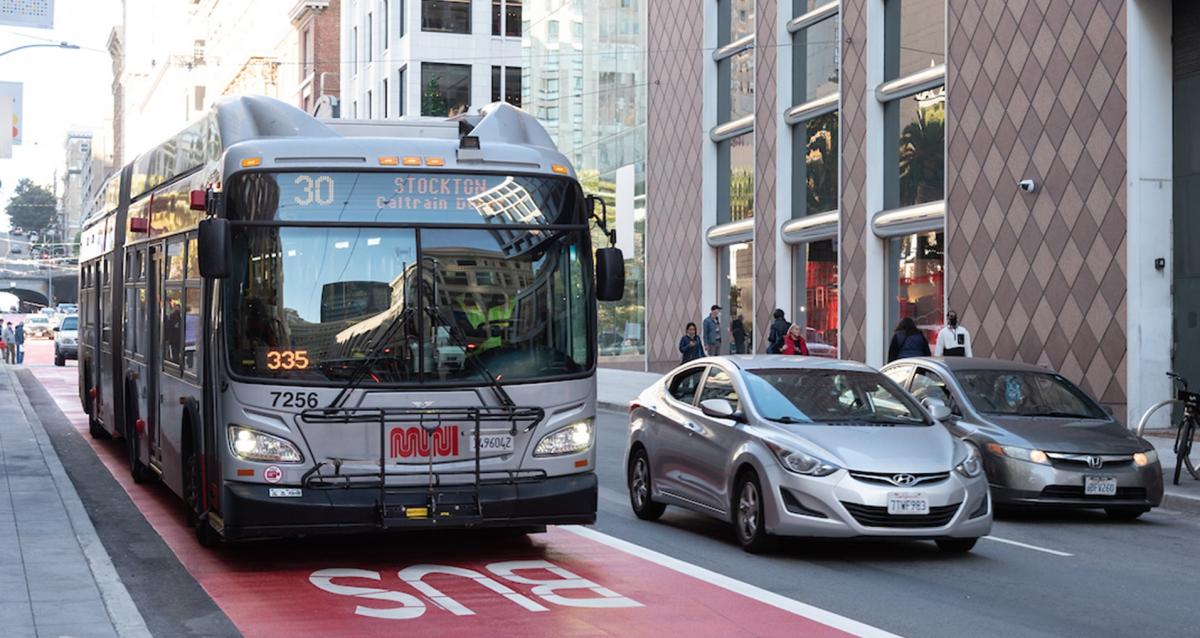
A photo of the 30 Stockton using the new, red transit lane on Stockton Street The SFMTA’s Muni Forward program is delivering transit reliability improvements that are transforming the Muni system and enhancing the customer experience. With 80 miles of upgrades since 2014 that often bring travel time savings of 20% or more, Muni Forward is making a big difference in how San Francisco moves. These upgrades, which can be seen in this Muni Forward Photo Map, draw from a “toolkit” of over 20 reliability and customer experience improvements, such as transit lanes that provided dedicated space for Muni vehicles to cut through traffic, transit bulbs that reduce delays at transit stops and traffic signals with transit priority that give the green light to transit vehicles as they approach the intersection, when possible.

The recently completed Van Ness Improvement Project thrust Muni Forward back into the spotlight with San Francisco’s first Bus Rapid Transit (BRT) corridor. While the Van Ness Improvement Project was a massive overhaul that required significantly more time and money to implement than the average Muni Forward project, we are seeing familiar benefits resulting from the transportation improvements. In just under two months, Muni riders on Van Ness are seeing a travel time savings of up to 35% northbound (up to nine minutes per trip) and 22% southbound on weekdays. After the first week of this drastically improved service, ridership on the 49 Van Ness-Mission increased by 13%.  

We’ve seen similar outcomes on past Muni Forward projects that share many features implemented on the BRT corridor. In addition to improved travel times and reliability, ridership has increased by 10% or more on many of the lines where Muni Forward improvements have been implemented, such as the 5R Fulton Rapid, 9R San Bruno Rapid and 38R Geary Rapid. And though ridership has decreased during the pandemic, it has returned fastest on many of the lines where we’ve made these improvements, such as the 22 Fillmore, which now has more riders than in 2019. 
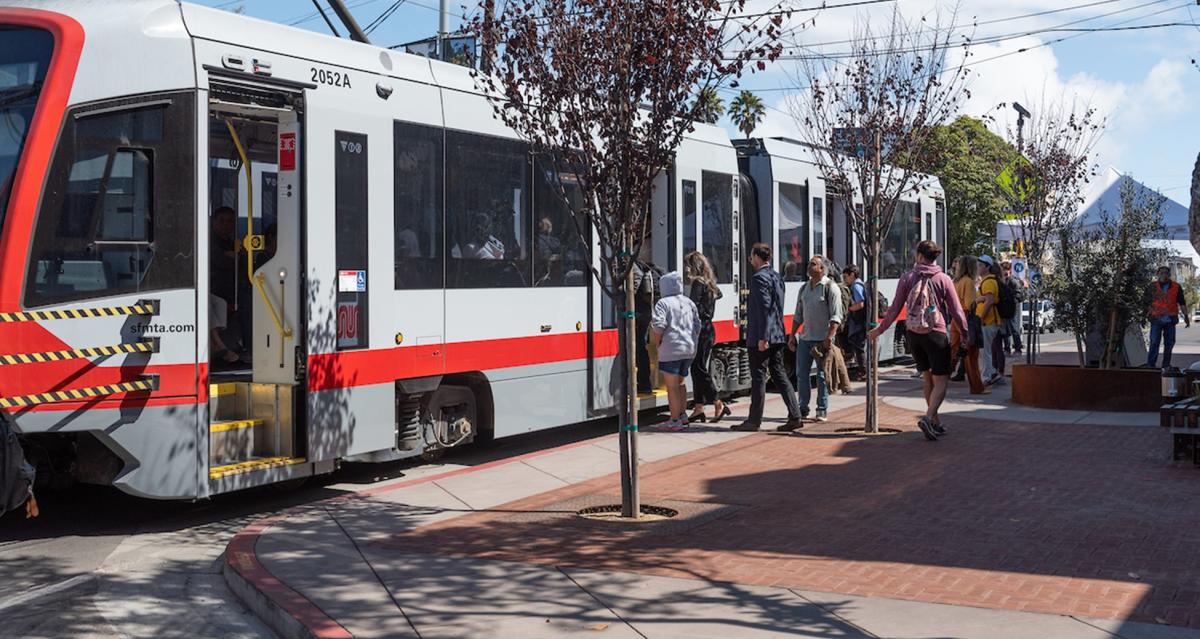
Photo of people boarding a Muni light rail vehicle using the new transit bulb on Irving Street.

New transit bulb on Irving Street

Thanks to Muni Forward, San Francisco now has over 60 miles of dedicated transit lanes. Among these are the lanes that were installed as part of the Temporary Emergency Transit Lanes program. Made permanent in late 2021 and early 2022, these lanes have provided travel time savings of up to 31% for routes that carry 40% of current Muni customers, including the T Third, 1 California, 14 Mission, 14R Mission Rapid, 19 Polk, 27 Bryant, 28 19th Avenue, 38 Geary, 38R Geary Rapid, 43 Masonic and 44 O’Shaughnessy. 
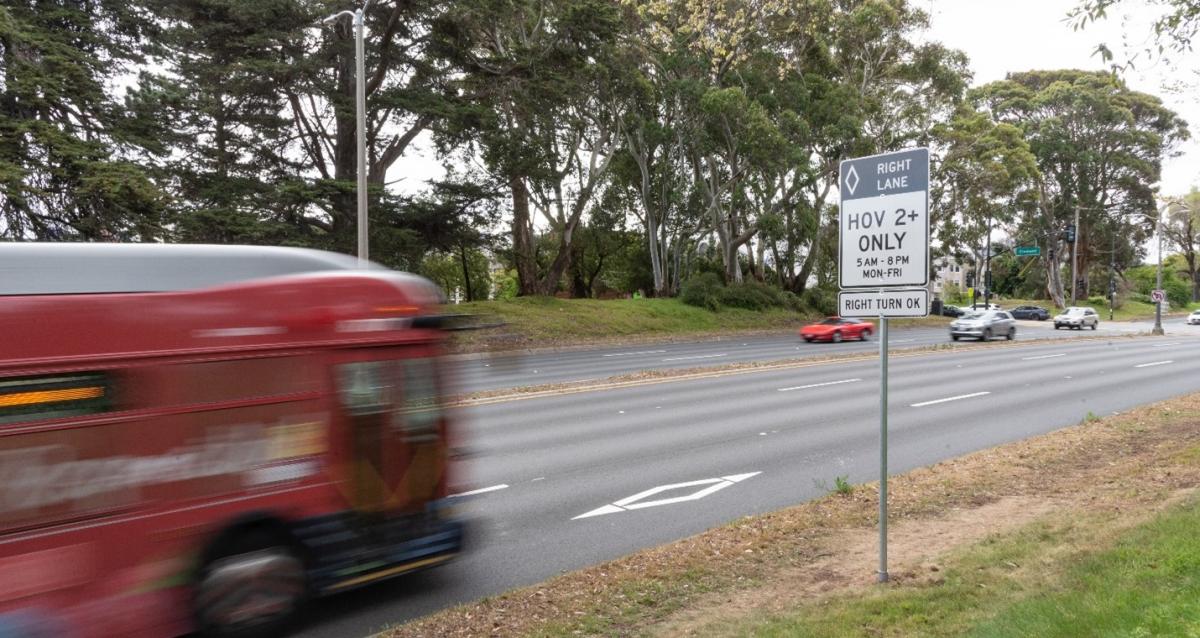
Photo of the new carpool lanes on Park Presidio Boulevard and the sign letting people know that the right lane is an HOV lane for two or more passengers.

New carpool lanes on Park Presidio Boulevard

Another notable recent Muni Forward project is the Park Presidio Lombard Temporary High-occupancy vehicle (HOV) lanes, which are the first urban arterial carpool lanes in the state. In partnership with Caltrans, this pilot project is already seeing travel time savings of up to 10%. 

Looking ahead, Muni Forward is not slowing down. Planning is underway for improvements on the 29 Sunset, and we’ve started construction on improvements to the 22 Fillmore, 28 19th Avenue and L Taraval. We’re also preparing for construction on improvements to the 14 Mission, 5 Fulton, 27 Bryant and 30 Stockton. Plans for transit delay hot spot improvements are also in the works, which will help improve Muni reliability at specific intersections where we have seen the most transit delay for Muni.  

Additionally, making improvements to Muni’s Metro service will be a major focus over the next few years. Upcoming Muni Forward projects will focus on surface-level improvements for the J Church, K Ingleside, M Ocean View, T Third and N Judah, which will complement the Muni Metro Modernization efforts that are already underway. 
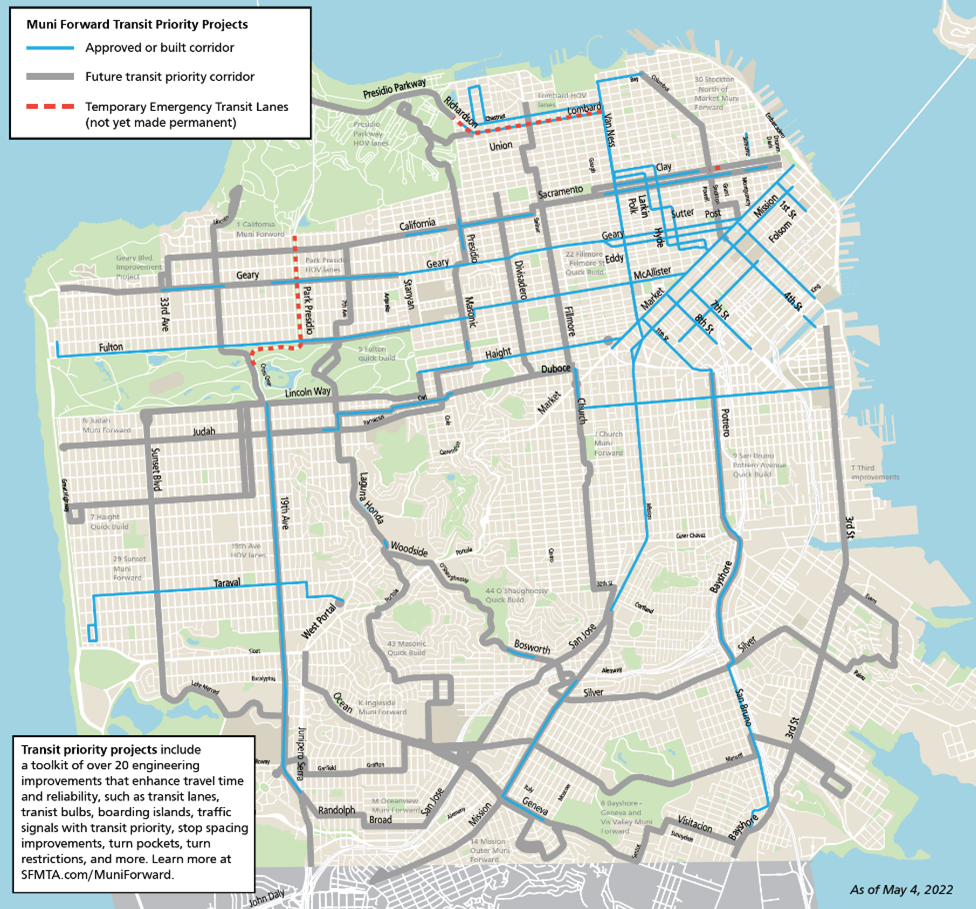
Map showing the Muni Forward transit priority projects across the city, including approved or built corridors, future transit priority corridors and temporary emergency transit lanes that are not yet made permanent.

Map of Muni Forward transit priority improvements

For a look at Muni Forward plans across the city, check out the map of Muni Forward transit priority improvements and see how Muni Forward is improving the system for customers, one project at a time.

Sign up to stay informed about future Muni Forward improvements.


Published June 03, 2022 at 04:08AM
https://ift.tt/noUG5ly

Comments

Popular posts from this blog

FOX NEWS: Intermittent fasting may cause muscle loss more than weight loss, study says Intermittent fasting might not be as healthy as some may have thought.

Intermittent fasting may cause muscle loss more than weight loss, study says Intermittent fasting might not be as healthy as some may have thought. via FOX NEWS https://ift.tt/2ShpJp3

New top story from Time: ‘We Are Standing up for Equal Treatment Before the Law.’ Pennsylvania Abolishes Prison Gerrymandering

https://ift.tt/3koSa1Z A Pennsylvania commission responsible for drawing the state’s legislative districts voted 3-2 on Tuesday to end prison gerrymandering, the practice of counting prisoners where they are incarcerated rather than in their last known residence before incarceration. Advocates have lauded the move as helping right an injustice that unfairly skews the state’s political power away from urban areas and communities of color. The change will apply to those incarcerated in a state correctional facility or state facility for adjudicated delinquents—but not to individuals in federal or county prison facilities or those serving a life sentence. (A spokesperson for Democratic House Minority Leader Rep. Joanna McClinton says that federal and county prison facilities were excluded because they don’t fall under the state’s jurisdiction, while people given life sentences were excluded because they are not expected to return to their homes.) [time-brightcove not-tgx=”t...

Nifty hits 14,000-mark on last trading day of 2020 https://ift.tt/3mZHV3K

On the last trading day of 2020, the National Stock Exchange breached the 14,000-mark for the first time to trade at 14007.5 at 10:40 am. 

New top story from Time: California Has the Second Confirmed Case of the Coronavirus Variant in the U.S.

https://ift.tt/3pz6pSY California on Wednesday announced the nation’s second confirmed case of the new and apparently more contagious variant of the coronavirus, offering a strong indication that the infection is spreading more widely in the United States. Gov. Gavin Newsom announced the infection found in Southern California during an online conversation with Dr. Anthony Fauci, head of the National Institute of Allergy and Infectious Diseases. “I don’t think Californians should think that this is odd. It’s to be expected,” Fauci said. Newsom did not provide any details about the person who was infected. The announcement came 24 hours after word of the first reported U.S. variant infection, which emerged in Colorado. That person was identified Wednesday as a Colorado National Guardsman who had been sent to help out at a nursing home struggling with an outbreak. Health officials said a second Guard member may have it too. The cases triggered a host of questions about h...

New top story from Time: A ‘History of Exclusion, of Erasure, of Invisibility.’ Why the Asian-American Story Is Missing From Many U.S. Classrooms

https://ift.tt/2Pdr7LQ On the morning of March 17, Liz Kleinrock contemplated calling out of work. The shootings at three Atlanta-area spas had happened the night before, leaving eight dead including six women of Asian descent, and Kleinrock, a 33-year-old teacher in Washington, D.C., who is Asian-American, felt the news weighing on her heavily. But instead of missing work, she changed up her lesson plan. She introduced her sixth graders over Zoom to poems written by people of Japanese ancestry incarcerated during World War II. Her lesson included “My Plea,” printed in 1945 by a young person named Mary Matsuzawa who was held at the Gila River Relocation Center in Arizona: “ I pray that someday every race / May stand on equal plane / And prejudice will find no dwelling place / In a peace that all may gain.” “I feel like so many Asian elders have been targeted because of this stereotype that Asians are meek and quiet and don’t speak up and don’t say anything, and the...

FOX NEWS: Top baby names list for 2021 reveals familiar trends For the second year in a row, these two names are the most popular for girls and boys – leading BabyCenter's Top 100 Baby Names list.

Top baby names list for 2021 reveals familiar trends For the second year in a row, these two names are the most popular for girls and boys – leading BabyCenter's Top 100 Baby Names list. via FOX NEWS https://ift.tt/2ZZEl3u

FOX NEWS: Top baby names list for 2021 reveals familiar trends For the second year in a row, these two names are the most popular for girls and boys – leading BabyCenter's Top 100 Baby Names list.

Top baby names list for 2021 reveals familiar trends For the second year in a row, these two names are the most popular for girls and boys – leading BabyCenter's Top 100 Baby Names list. via FOX NEWS https://ift.tt/2ZZEl3u

Watch San Francisco’s Bike Network Bloom

Watch San Francisco’s Bike Network Bloom By Eillie Anzilotti From just a few stretches of scattered lanes in 2013, San Francisco’s protected bike network now stretches like a green web connecting more and more of the city. See how much has changed over the last eight years:   In just the blink of an eye, San Francisco has become one of the most bike-friendly cities in the U.S. To date, San Francisco has 464 miles of bikeways, including: 42 miles of protected bike lanes 78 miles of off-street paths and trails 21 miles of buffered bike lanes 139 miles of striped bike lanes As we’ve expanded the network of safer bicycle routes through San Francisco, more people are choosing to ride bicycles for recreation and transportation every year. Since 2006, travel by bicycle has grown by 184 percent citywide. Before the COVID-19 pandemic, bike counts hit an all-time high: in 2019, approximately 52,000 bicyclists were observed at 37 locations during peak periods, a 14 percent incre...

Punjab farmers stir is to siphon off taxpayers' Rs 6,500 crore: Vijay Sardana https://ift.tt/3fN9niY

Farmers' protest against the Centre's three agriculture laws on Monday entered the fifth day. The farmers are demanding from the government to withdraw the three laws which according to them is not in the interest of the farming community. However, noted agriculture sector expert and economist, Vijay Sardana, said that the agitation is not about the laws, but it is about the traders who will be at loss.

New top story from Time: How Liberal White America Turned Its Back on James Baldwin in the 1960s

https://ift.tt/2QBsNzv In discussions about race relations today, the works of James Baldwin continue to speak to the present, even decades after they were written. So it is worth remembering that, at the very height of his influence, Baldwin experienced the same frustration that some Black activists, particularly on campus, feel about white liberals today: their refusal to acknowledge their complicity in the regime of white supremacy. In Baldwin’s case, the liberal backlash was widespread, and effectively marginalized him for a time. The very first piece on the front page of the very first issue of The New York Review of Books , Feb. 1, 1963, was a review of Baldwin’s The Fire Next Time by F. W. Dupee of the Columbia English department. Dupee (a former Communist Party organizer) took exception to Baldwin’s apocalyptic tone. “Do I really want to be integrated into a burning house?” Baldwin had written. The answer, Dupee wrote, is that “[s]ince you have no other, yes; and t...